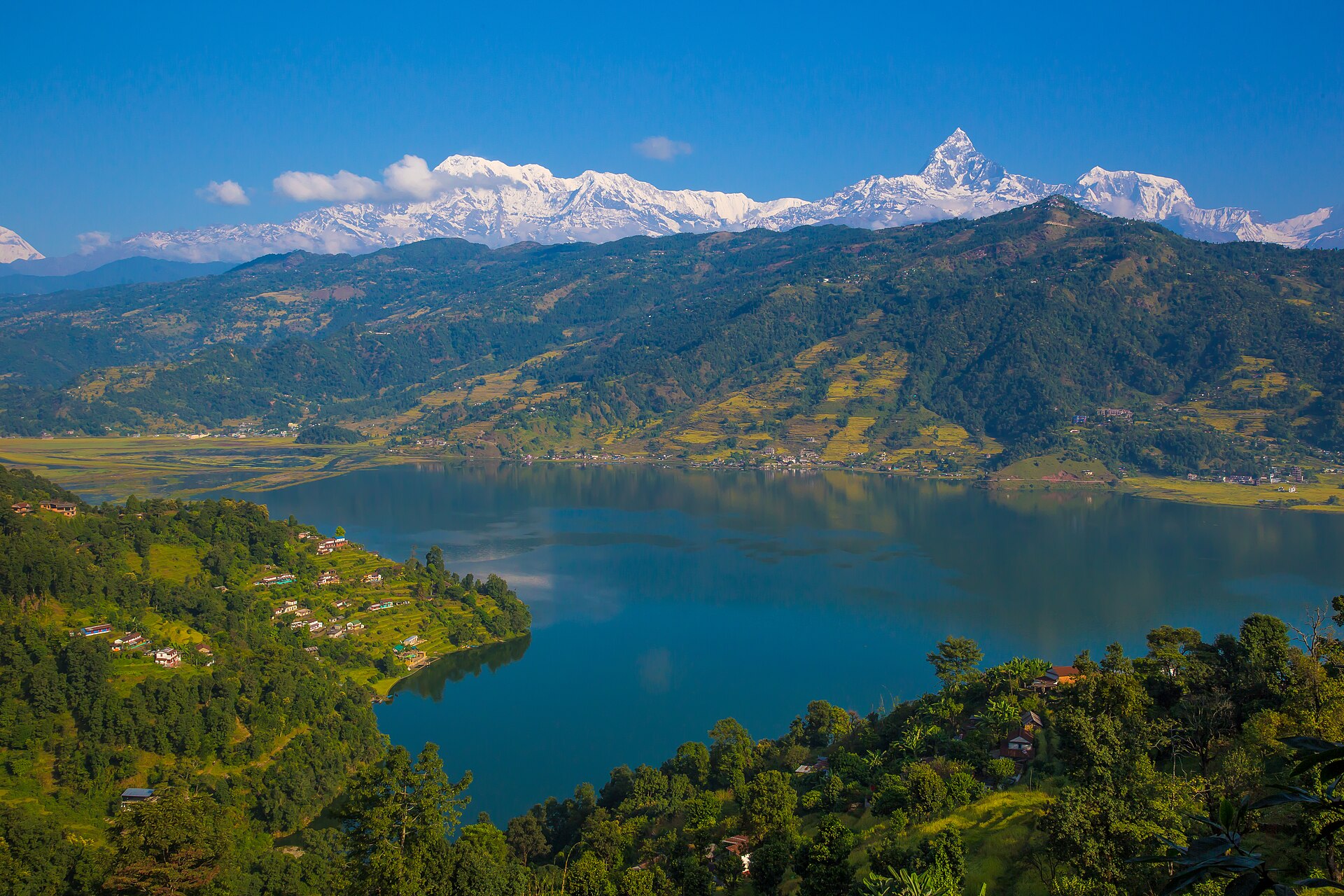
Nepal is the country of eight of the world’s fourteen highest peaks. Though it is known by the name of Everest, most of a trip there passes without climbing a mountain. You start with the temple squares of Kathmandu, in Pokhara the Annapurna view opens from the lakeside, in Chitwan you see elephants and rhinos, and Lumbini is the place where the Buddha was born.
For us the visa is bought at the airport for thirty dollars. The country is among the cheapest in Asia, and a week there costs what a weekend costs in Baku. Below I have gathered Kathmandu and Pokhara, the trekking options and the permits, and Chitwan, the transport, the altitude rule, the food, the season and the budget.
Nepal in brief
| Capital | Kathmandu, at 1,400 metres |
| Language | Nepali; English everywhere in tourism |
| Currency | Nepalese rupee (NPR), 1 dollar ≈ 135 rupees; cash is the basis, cards only in the city |
| Visa | At the airport or online: 15 days 30, 30 days 50, 90 days 125 dollars |
| Best time | October–November and March–April; June–September is the monsoon |
| Flights | 9–12 hours via Doha, Dubai, Istanbul or Delhi |
| Daily budget | 40–60 dollars at a mid-range level; 30–50 on a trek |
The Kathmandu valley and Pokhara
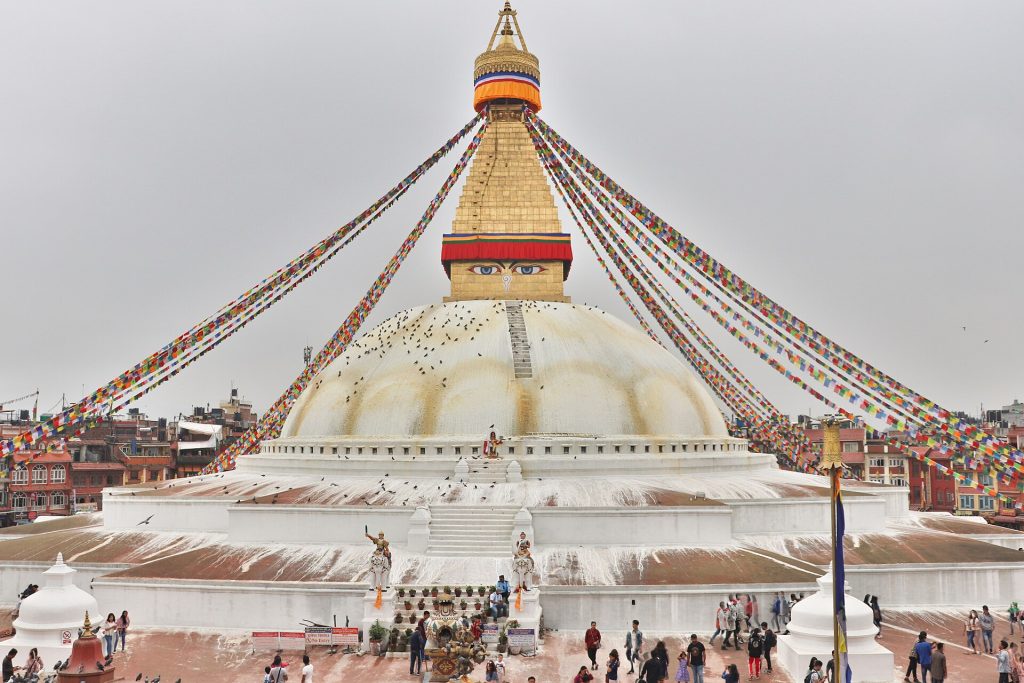
Kathmandu is a chaotic, dusty and miraculous city, all three at once. On Durbar Square there are royal palaces and wooden temples, still being restored after the 2015 earthquake. Swayambhunath is called «the monkey temple», gives a view of the city from its hill, and the monkeys really are many. Boudhanath is the largest stupa in Asia, and in the evening you should walk around it with the pilgrims. Pashupatinath is a Hindu temple on the bank of the Bagmati river where cremation ceremonies are held. It is a heavy sight, so be ready. The Thamel quarter is the tourist centre: trekking shops, cafés, everything is there.
In the valley there is Bhaktapur, a medieval city with its pottery square, and Patan, the city of craftsmen — half a day each — and from the village of Nagarkot the Himalayan range at sunrise. Pokhara is two hundred kilometres from Kathmandu, a quiet resort town on the shore of Lake Phewa, and after Kathmandu you finally breathe. In the morning you watch the sun rise over the Annapurna and Machhapuchhre peaks from the Sarangkot hill. Paragliding over the lake is 80–100 dollars and this is one of the best places in the world for it. The World Peace Pagoda, Devi’s Fall and the lakeside restaurants are here too. The town is at the same time the base for the treks.
Trekking in Nepal: Everest, Annapurna, Poon Hill and the permits
Trekking in Nepal is built on the «teahouse», that is the mountain lodge system: no tent is needed, and every village has a bed and a meal.
Everest base camp takes twelve to fourteen days. The route starts with a thirty-minute flight from Kathmandu to the Lukla airstrip, which counts as the most dangerous landing strip in the world, and the pilot is applauded after touching down. Namche Bazaar and the Tengboche monastery lie along the way, and from Kala Patthar at five thousand five hundred and forty-five metres the view of Everest opens. This route demands serious physical preparation and days of acclimatisation.
Annapurna base camp takes seven to ten days from Pokhara and stands at four thousand one hundred and thirty metres; it is greener and warmer there. The Annapurna circuit, meanwhile, is twelve to eighteen days, and its highest point is the Thorong La pass at five thousand four hundred and sixteen metres.
For a beginner Poon Hill is ideal: it takes three or four days, climbs to three thousand two hundred and ten metres and gives the whole Annapurna panorama, and older people and families with children go there too. Langtang is seven days and close to Kathmandu.
The rules are these. The national park permit is 25–30 dollars and the TIMS card 15. In the national parks a licensed guide is compulsory; a guide takes 25–35 dollars a day and a porter 20–25.
Altitude sickness is a serious matter and does not care whether you are an athlete. Do not climb more than three hundred to five hundred metres a day, come down at once if the headache and nausea do not pass, and take insurance that covers helicopter evacuation.
Chitwan, Lumbini and getting around Nepal
Chitwan national park is on the Indian border, in the middle of the jungle. On a jeep safari you see one-horned rhinos, elephants and crocodiles, and on rare occasions a tiger. The programme also includes a canoe trip and the Tharu villages, and there are lodges in the village of Sauraha. Set aside two days; the journey from Pokhara takes five hours. Lumbini is the birthplace of the Buddha, with the Maya Devi temple and monasteries built by countries from around the world, and half a day is enough.
As for transport, the tourist bus from Kathmandu to Pokhara takes seven to eight hours and costs 10–25 dollars, and the road is jammed and full of potholes. The flight is only twenty-five minutes and comes to 100–130 dollars; the whole Himalaya is visible from the window, so sit on the left.
The domestic flights are run by Buddha Air and Yeti Airlines. Lukla flights are often cancelled because of the weather, so plan a spare day or two. In the city a motorbike or car taxi through the Pathao and inDrive apps is 1–3 dollars, while the Kathmandu traffic is heavy. A car with a driver is 50–80 dollars, and do not even think about driving yourself.
Dal bhat, momo, thukpa: Nepali food
Dal bhat is lentil soup, rice, vegetable curry and pickle. It is the staple of the trekking trail, and even the saying «dal bhat power 24 hour» came from there. Refills are free, they keep bringing it until you are full, and the price is 3–5 dollars.
Momo is a Tibetan-style steamed dumpling and a mountain relative of our dushbara. Thukpa is a noodle soup. In Kathmandu Newar cooking is known for chura and choila, sel roti is a sweet ring, and chiya is milky tea. In the mountains they serve tongba, that is hot millet beer.
Vegetarian food is the staple everywhere, while meat in the mountains is both scarce and expensive, because it goes up on a porter’s back. Halal food can be found in the Muslim quarter of Kathmandu and in a few restaurants in Thamel; dal bhat itself is meatless anyway, and ask for the momo with chicken.
Lunch in a restaurant in Thamel is 4–8 dollars. In the mountain lodges the price rises with the altitude, and at five thousand metres dal bhat is already 8–10 dollars. Drink only bottled or filtered water, and take water purification tablets into the mountains.
Read next: A Nepal visa on arrival: 30, 50, 125 dollars and the trekking permits
Season and weather
October-November is the best time of the year. The monsoon ends, the air clears and the mountains are fully visible, and the Dashain and Tihar festivals fall in those months too. The trekking trails, meanwhile, are at their busiest.
March-April is the second season: the rhododendron forests bloom and the air gets a little hazy. From December to February the weather in Kathmandu and Pokhara stays sunny at 15–20 degrees, and the nights turn cold. The high treks are snowy in that period, while the lower routes are quiet and cheap.
From June to September the monsoon rains. Daily downpours, leeches, cancelled flights and clouded mountains await you, and you can only go to regions that stay in the rain shadow, such as Mustang and Dolpo. The permit rules and trekking information are on the Nepal Tourism Board portal.
Budget and tickets
In Thamel a guest house is 15–30 dollars and a boutique hotel 50–90. In Pokhara a lakeside hotel is 25–50 dollars, and a Chitwan lodge with the safari comes to 60–120. A night in a mountain lodge is 3–8 dollars, with the food counted separately. Before and after the trek it is easy to find a cheap bed in Thamel.
The programmes are priced like this. The Everest base camp trek with a guide, the flight and the permits is 1,200–2,000 dollars, Poon Hill 300–500, a Chitwan safari 50 and paragliding 90. Excluding the flight, a two-week trip including a trek fits into 900–1,500 dollars per person.
Qatar Airways, flydubai and Turkish Airlines fly to Kathmandu; an air ticket to Kathmandu gets dearer in October-November, while the option via Delhi works out cheap. Nepal trekking tour packages that give you an Everest or Annapurna trek along with Pokhara and Chitwan in one programme settle the guide, the permit and the insurance together, and for a first trek that is the safest way.
Frequently asked questions about Nepal
How many days does a Nepal trip need?
Without a trek, Kathmandu, Pokhara and Chitwan take eight to ten days. With Poon Hill twelve days, and with Everest base camp eighteen to twenty.
Do you have to be an athlete to trek?
No, Poon Hill and Annapurna base camp are for anyone in average physical shape: five or six hours of slow walking a day. The Everest trek is longer and higher and needs preparation beforehand and patience.
Can you see Everest without climbing?
Yes: the morning «mountain flight» from Kathmandu is an hour and 200 dollars, and Nagarkot and Poon Hill show you the range. Everest itself is visible from the Lukla side or from the flight.
In closing
Nepal is a country that gives you a visa on arrival, very cheap prices and the highest mountains in the world with the comfort of a lodge, and for someone who picks the season correctly and respects the altitude it is a trip of a lifetime. The visa and permit rules are explained on the Nepal page, and to build the trek or the valley route together, fill in the application form.
Note: the prices here are as of the publication date and can change with the season.
