Uzbekistan is the heart of the Silk Road. Samarkand’s Registan square, Bukhara’s thousand-year-old streets and Khiva’s walled city join up in one route, all of them covered in turquoise domes and tilework.
For us it is one of the easiest long trips. There is no visa, there is a direct flight from Baku to Tashkent, and language is no trouble — you understand half of what is said in Uzbek. Everything is halal, prices sit at our level, and the high-speed train links three historic cities in a single day. Below I have gathered Tashkent, Samarkand, Bukhara and Khiva, along with the Afrosiyob train, the food, the season, the registration rule and the budget.
Uzbekistan in brief
| Capital | Tashkent, the largest city in Central Asia |
| Language | Uzbek, close to Azerbaijani; Russian everywhere |
| Currency | Som (UZS), 1 dollar ≈ 12,700 som; Visa and Mastercard in the cities, cash at the bazaar |
| Visa | 90 days visa-free for citizens of Azerbaijan; no registration for up to 15 days |
| Best time | April–May and September–October |
| Flights | Baku–Tashkent direct, AZAL and Uzbekistan Airways, 3.5 hours |
| Daily budget | 50–80 dollars at a mid-range level |
Tashkent and Samarkand
Tashkent is the gateway, rebuilt in Soviet style after the 1966 earthquake, and one day is enough. Under the blue dome of the Chorsu bazaar they sell spices, non bread and dried fruit. The Hazrati Imam complex holds one of the world’s oldest Qurans. Amir Timur square is the centre. The metro stations are among the most beautiful anywhere — see Kosmonavtlar and Alisher Navoi without fail; one ticket lets you tour them all. At the plov centre a giant cauldron is served at midday and it is finished by one o’clock, so do not be late.
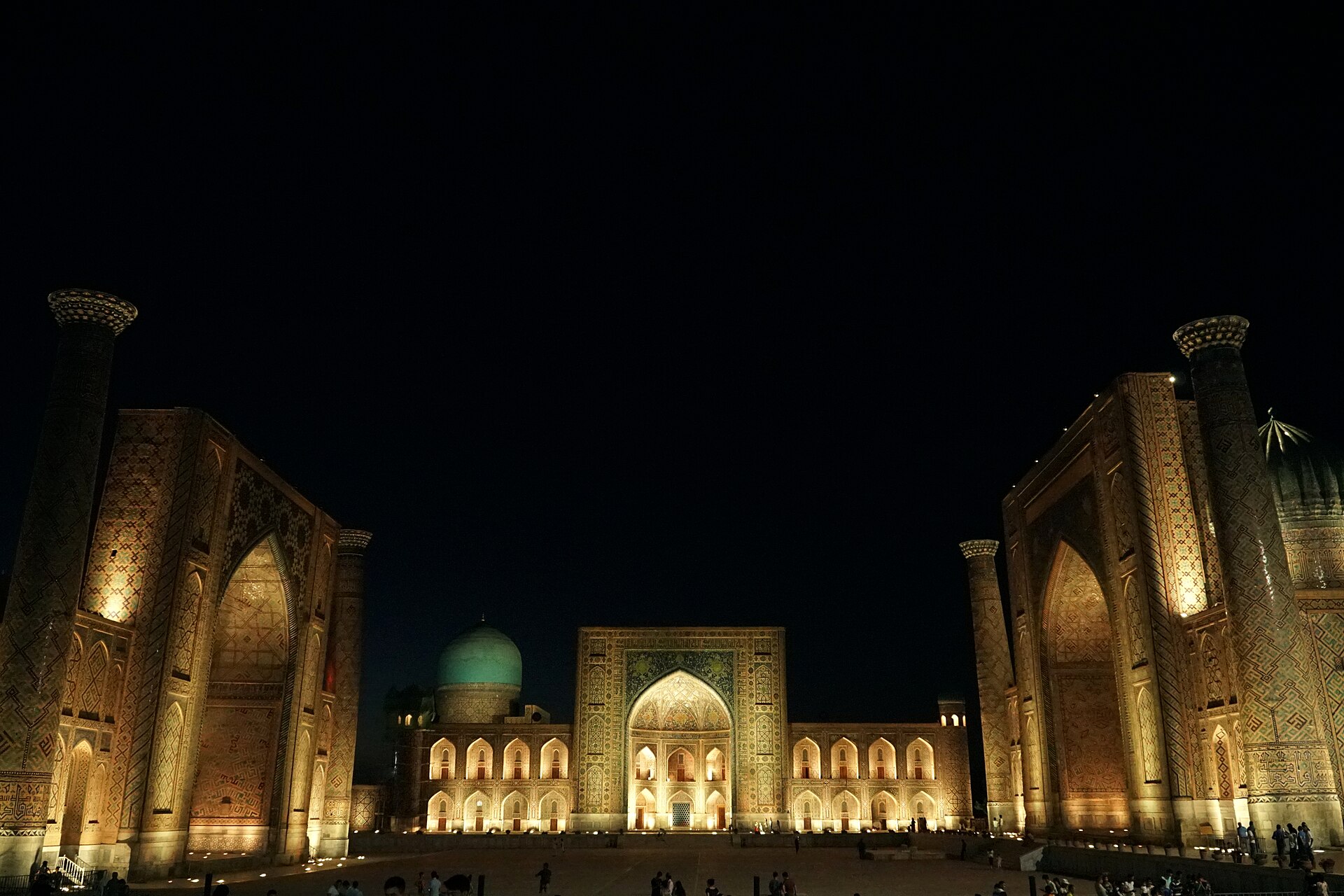
Samarkand is two hours away on the Afrosiyob train and wants two days. The Registan square with its three madrasas is the summit of Islamic architecture; people fall silent when they step onto it. There is a light show in the evening. Shah-i-Zinda is a street of mausoleums and, with its turquoise tilework, is considered the most beautiful place in the country. The Bibi-Khanym mosque, Timur’s tomb Gur-e-Amir and Ulugh Beg’s observatory are here too. The Siyob bazaar shows the city’s daily life. The city is lit at night and the Registan can be seen for free after dark — it is finer than by day.
Bukhara, Khiva, Fergana: Uzbekistan along the Silk Road
Bukhara is an hour and a half from Samarkand by train and, unlike Samarkand, it is a living old town that has survived whole. The Poi-Kalon complex stands at the city’s centre with its forty-seven-metre minaret. Around Lyabi-Hauz there are teahouses and mulberry trees, and drinking tea there in the evening and watching people is the best thing the city offers. The Ark citadel, Chor Minor and the three covered trading domes are nearby. The Ismail Samani mausoleum astonishes with its thousand-year-old brickwork. Set aside two days and choose a guesthouse in one of the traditional courtyard homes.
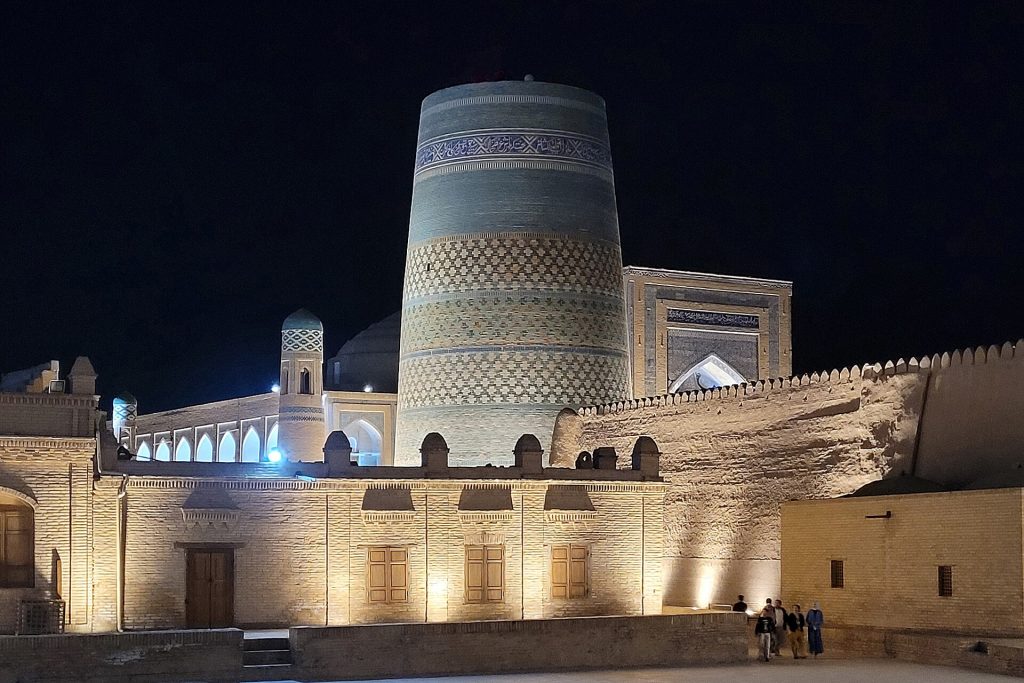
You reach Khiva from Bukhara on a six-hour train or by a one-hour flight via Urgench. The walled city of Ichan-Kala is on the UNESCO list and is an open-air museum in its entirety. Kalta Minor is an unfinished turquoise minaret, and the Juma mosque has two hundred and thirteen wooden columns. Watch the sunset from the Islam Khoja minaret and give the city a day or two.
The Fergana valley is four hours from Tashkent. Margilan has a silk factory, Rishtan its ceramics workshops and Kokand a palace. There are few tourists; this is the country’s warmest side.
In Nukus the Savitsky museum holds a hidden collection of Soviet avant-garde, and in Moynaq what remains of the Aral Sea and its ship graveyard.
The Afrosiyob train, Yandex and paying in Uzbekistan
The Afrosiyob is a Spanish Talgo high-speed train. Tashkent to Samarkand takes two hours and costs 10–15 dollars; Bukhara takes four hours and costs 15–25. Tickets open forty-five days ahead on the Uzbek railways site and app and sell out fast in season — take that seriously. The Sharq and overnight trains are the cheap alternative, and the train from Bukhara to Khiva runs six hours.
Domestic flights are run by Uzbekistan Airways; Tashkent to Urgench takes an hour and a half and costs 40–70 dollars. There are shared intercity taxis too: Samarkand to Bukhara in three hours for 10–15 dollars.
Within the cities Yandex Go taxis are very cheap, just 1–3 dollars. The Tashkent metro is fifteen cents, and the old towns of Samarkand and Bukhara are walked. Yandex Go needs internet, so with an eSIM connected you can call a taxi from day one.
As for paying, international cards work in hotels, restaurants and cash machines, while the bazaar and taxis are cash. Dollars are easily changed at exchange offices at the official rate, so take large notes with you.
Registration is done automatically by hotels. The rule for anyone staying more than fifteen days is in our visa article.
Plov, samsa, non: the Uzbek kitchen
Plov differs in every city and you can argue about it. Tashkent plov is cooked with yellow carrot and chickpeas. Samarkand plov is laid out in layers, and Bukhara plov is sweet. Plov is eaten at midday and not cooked in the evening. Anyone asking for plov at night is immediately marked as a tourist. Samsa is baked in a tandoor with meat and onion, and shashlik is done over coals. Lagman is hand-pulled noodles, served alongside manti, shurpa and dimlama. Khiva’s shivit oshi is a green noodle. Non bread is baked with a different pattern in each city, and Samarkand non is carried back to Baku as a gift. Green tea starts every table. In summer the melons and grapes are the sweetest in the world. Everything is halal. Lunch in a teahouse is 3–5 dollars, in a tourist restaurant 8–12, and on a terrace with a Registan view 15. Do not drink the tap water; bottled water is cheap.
Season and weather
April–May and September–October are the ideal months, with temperatures of 20–28 degrees. Spring is full of blossom and autumn is the melon and grape season. It is also the peak of tourism, when hotels and Afrosiyob tickets run out.
From June to August it climbs to 38–45 degrees. Desert heat rules in Khiva and Bukhara, so keep your walking to the morning and evening; in exchange, hotels drop to half price.
From November to March it is cold and grey, snow falls in Tashkent, tourists thin out, and the Registan under snow has a beauty all of its own. Novruz is celebrated across the country on the twenty-first of March with sumalak and street festivities — a scene familiar to us.
Near Tashkent, the Chimgan mountains and Lake Charvak give coolness in summer, and in winter there is skiing at the Amirsoy resort. Regional and event information is on the Uzbekistan Travel portal.
Budget and tickets
A three-star hotel in Tashkent costs 40–60 dollars. In Samarkand and Bukhara a traditional courtyard boutique hotel is 40–80 dollars and a guesthouse 20–35. In Khiva, inside Ichan-Kala, the price is 30–60. Staying within the walls means seeing the city empty in the evening, so check the location on the map.
Entry tickets are cheap. The Registan is 10 dollars, Shah-i-Zinda 5, Khiva’s combined ticket 15 and the Ark citadel 4. Excluding the flight, a week-long trip fits into 500–800 dollars per person.
AZAL and Uzbekistan Airways fly daily from Baku to Tashkent, and there are seasonal flights to Samarkand too. Tickets to Tashkent should be bought early for Novruz and the autumn season. Uzbekistan Silk Road tour packages fitting Tashkent, Samarkand, Bukhara and Khiva into one week settle the Afrosiyob tickets, the domestic flight and the guide in one go — and in season that is the easiest way to get a seat at all.
Frequently asked questions about Uzbekistan
How many days does a trip to Uzbekistan need?
Tashkent one day, Samarkand two, Bukhara two, Khiva one or two — a week in all. Ten days with Fergana or Nukus.
Can you travel on an ID card?
No, you need a foreign passport. Staying more than fifteen days brings the registration rule into play, and hotels handle it automatically.
Samarkand or Bukhara?
Samarkand is magnificent monuments; Bukhara is a living old town that has survived whole. They are an hour and a half apart — see both, and Khiva completes the three.
In closing
Uzbekistan is a Silk Road trip with no visa, a direct flight, low prices and no language barrier; with the right Afrosiyob ticket and the right season, three world cities fit into one week. The entry and registration rules are gathered on the Uzbekistan page, and to build the Silk Road route together, fill in the application form.
Note: the prices here are as of the publication date and can change with the season.
