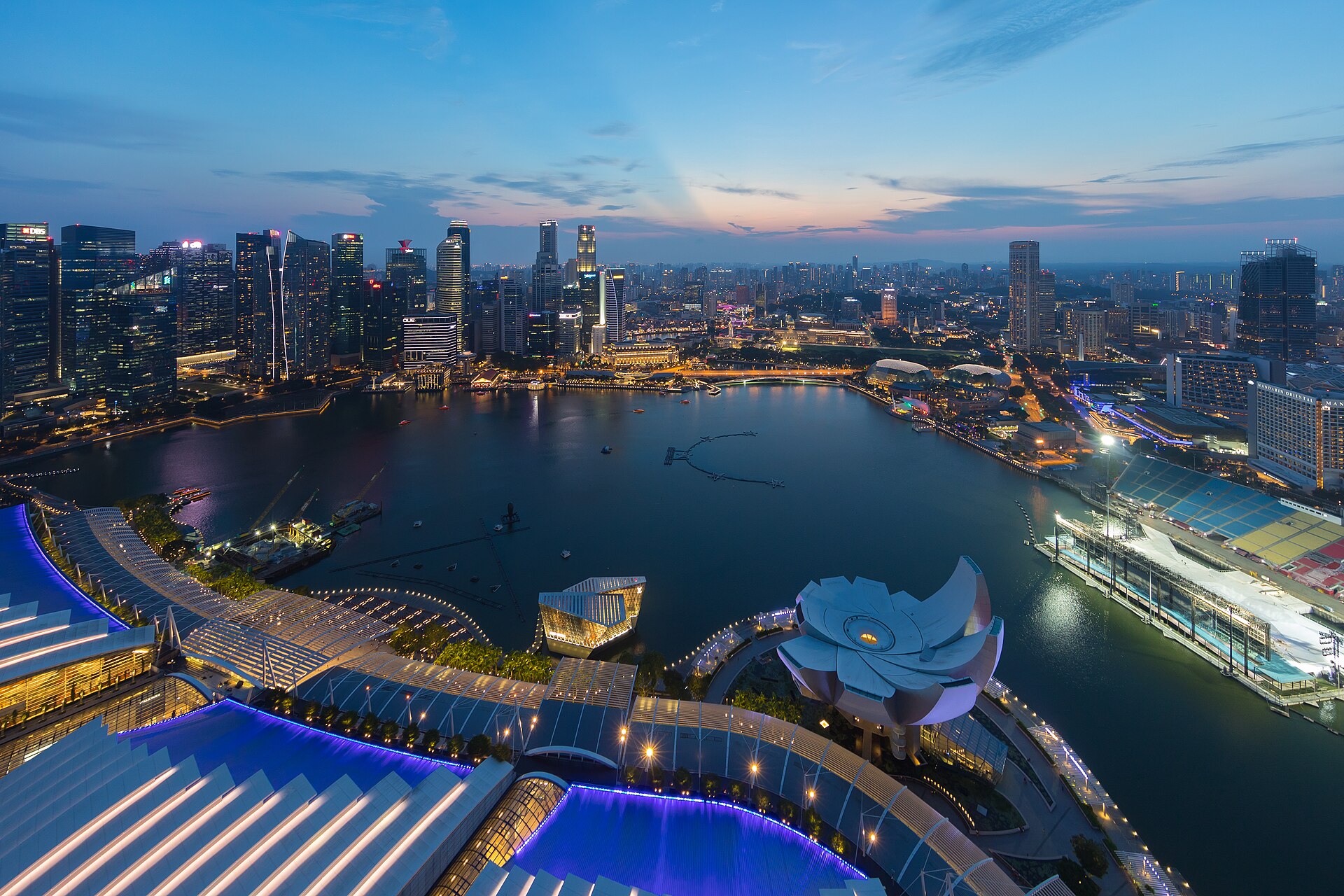
Singapore is a country the size of a city, and that city is the cleanest, safest and best organised place in the world. The rooftop pool at Marina Bay Sands and the Supertrees lit up at night are its symbols. At the hawker centres you eat Michelin-starred food for three dollars, and Sentosa’s beaches and the Chinese, Indian and Malay quarters all sit along one metro line.
For us the visa is a separate conversation. You cannot apply yourself; you need a sponsor or an agent. Even so, entering visa-free on a ninety-six-hour transit is possible, and that is the route I recommend to most people. Below I have gathered the main sights, the quarters, the food, transport, the famous rules, the visa and transit options, the season and the budget.
Singapore in brief
| Status | City-state, 6 million people, 730 square kilometres |
| Language | English, Malay, Chinese and Tamil; English everywhere |
| Currency | Singapore dollar (SGD), 1 US dollar ≈ 1.35 SGD; cards everywhere |
| Visa | Through a sponsor or agent, 30 dollars; visa-free 96-hour transit under conditions |
| Best time | 30 degrees all year; February–April and July–August relatively dry |
| Flights | 12–14 hours via Doha, Dubai or Istanbul |
| Daily budget | 150–250 SGD at a mid-range level |
Marina Bay, Gardens by the Bay, Sentosa
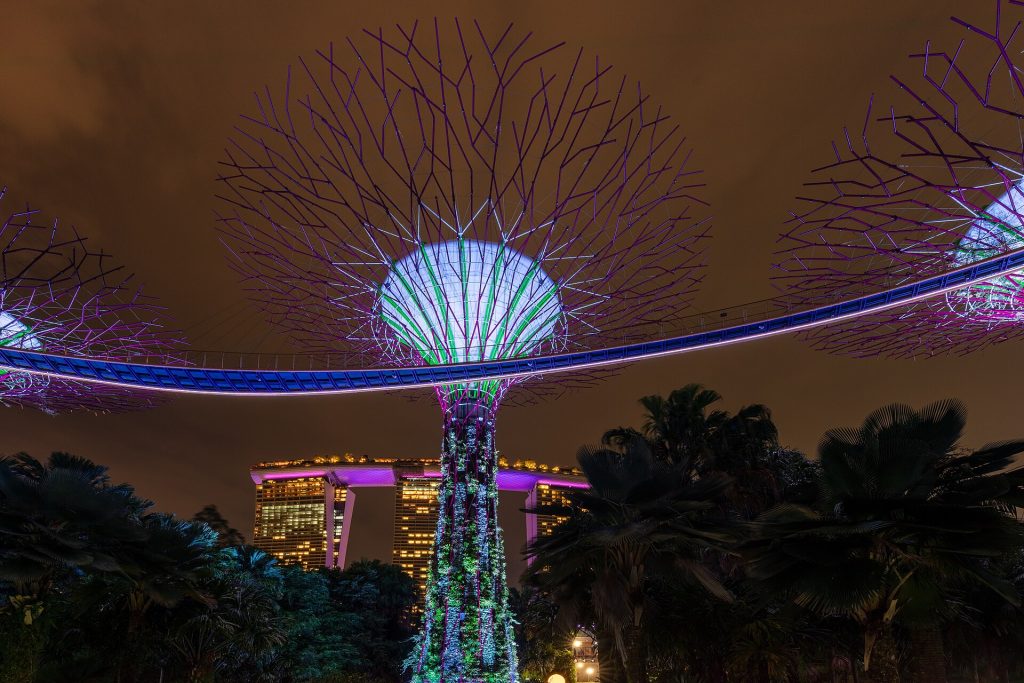
Marina Bay is the city’s shop window. The ship-shaped Marina Bay Sands stands on three towers. The SkyPark viewing terrace is 32 SGD, while the infinity pool is open only to hotel guests. Every evening there is a free Spectra light show over the bay. The Merlion statue, the lotus-shaped ArtScience museum and the Helix bridge are here too. Gardens by the Bay is right beside it, with its fifty-metre Supertrees and the OCBC Skyway walkway. The Garden Rhapsody light and music show is free every evening at 19:45 and 20:45. Inside the Flower Dome and Cloud Forest glasshouses there is a thirty-five-metre indoor waterfall; the ticket is 50 SGD. I prefer Cloud Forest.
You cross to Sentosa island by cable car or monorail. Universal Studios and the S.E.A. aquarium are there. So are Siloso and Palawan beaches, and the Wings of Time show in the evening. With a child, give it a full day. Jewel Changi, inside the airport, holds the world’s tallest indoor waterfall; set aside two hours before your flight and you will not regret it. The zoo and the Night Safari are among the best anywhere, and the Botanic Gardens are on the UNESCO list and free.
Quarters and hawker centres: Singapore at the table
Chinatown is known for its colourful shophouses, the Buddha Tooth Relic temple and the Maxwell hawker centre, where Tian Tian’s chicken rice is the city’s most famous plate. Little India has Serangoon Road, the Sri Veeramakaliamman temple, the Tekka market and the round-the-clock Mustafa store.
Kampong Glam is Singapore’s Malay-Muslim heart. The Sultan mosque, Arab Street, the Haji Lane graffiti and halal restaurants are all together, and that is exactly where I suggest booking a hotel.
The other quarters are a matter of taste. Orchard Road is the shopping street, Clarke Quay means riverside nightlife, Tiong Bahru is known for its quiet cafés, and Katong stands out for its Peranakan houses and laksa.
Hawker centres are on UNESCO’s intangible heritage list and gather dozens of stalls under one roof. Chicken rice, laksa, char kway teow, satay, chilli crab, roti prata and kaya toast run from 3 to 8 SGD, and the most famous centres are Lau Pa Sat and Old Airport Road.
Halal food is very easy here. Malay stalls are certified halal, Kampong Glam is an entirely halal district, and at hawker centres the halal stalls carry their own sign.
The MRT, Grab and Singapore’s rules
The MRT metro has six lines and runs clean and on time. You tap straight through with a contactless bank card, a ride costs 1–2.5 SGD, and an EZ-Link card is the alternative. From Changi airport the MRT reaches the centre in forty-five minutes for 2 SGD, while a taxi takes 30–40. You will be running both the card and the map from your phone, so landing with an eSIM is the easiest way.
Buses take the same card, and the Sentosa monorail is 4 SGD. Grab costs 10–20 SGD across the city and rises at night and in peak hours; ComfortDelGro taxis run on the meter. A car is unnecessary, and very expensive besides.
The rules are famous and the fines really are enforced. Importing chewing gum is banned, eating or drinking on the metro costs five hundred SGD and littering three hundred. Smoking is only allowed in marked places, and you cannot board public transport with a durian. Drugs carry the death penalty, and noise and vandalism are taken seriously too.
All of this buys something in return: walking alone at two in the morning is completely normal here. The tap water is fine to drink as well.
The visa and the 96-hour transit: how to enter Singapore
Citizens of Azerbaijan cannot obtain the visa directly. The application is made online through a sponsor resident in Singapore or a licensed visa agent; the fee is 30 SGD, the answer comes in 3–5 working days, and the visa is usually thirty days and multiple entry. Tour companies include this in the package.
The alternative is the ninety-six-hour visa-free transit. Flying on to a third country, Bali or Australia for instance, you may stay in Singapore for up to four days. The condition is a valid US, Canadian, British, Australian, Japanese, New Zealand, Swiss or German visa. A Schengen visa does not count for this list; the details are in our visa article.
Three days before arrival the SG Arrival Card is filled in online, and it is free. Changi is considered the world’s best airport, and in transit they offer a free city tour.
Season and weather
The city lies just a hundred and thirty-seven kilometres from the equator, so the temperature stays at 26–33 degrees all year and humidity reaches eighty per cent. Afternoon downpours are normal and an umbrella should always be in your bag. Indoors the air conditioning bites, so bring a thin jacket.
From November to January the north-east monsoon brings more rain. February to April are the driest and hottest months, and June to August are relatively comfortable. In September and October haze from Indonesian fires can drift over.
Check the calendar too. Chinese New Year decorates the city in January or February, but many shops close. The Formula 1 night race in September triples hotel prices, and the Great Singapore Sale falls in June and July. Event and ticket information is on the Visit Singapore portal.
Budget and tickets
Singapore is Asia’s most expensive city. A three-star hotel costs 150–220 SGD and a four-star 250–400; Marina Bay Sands starts at 600 SGD and a hostel capsule is 40–60. Prices are lower in Little India and Geylang, and if you compare hotels before booking you see the difference at once.
The sights are expensive as well. The Gardens domes are 50 SGD, SkyPark 32, Universal Studios 85 and the Night Safari 55. The Spectra and Supertree shows are free even so. A meal at a hawker centre is 5 SGD and at a restaurant 30–50, and excluding the flight a four-day trip fits into 700–1100 SGD per person.
Qatar Airways, Emirates and Turkish Airlines fly to Singapore, and a ticket to Singapore is often bought as a stopover on a Bali or Australia ticket. For anyone touring Singapore with Bali, or Singapore with Malaysia, on one route, tour packages settle the visa in the agent’s role — and for this country that really is the simplest way.
Frequently asked questions about Singapore
How many days does Singapore need?
Three or four days is ideal for the main sights, and it matches the transit’s 96 hours. For a longer trip, combine it with Malaysia or Bali.
Is Singapore good with children?
Singapore is the most child-friendly city in Asia. Universal Studios, the zoo, the Night Safari, Jewel and Sentosa’s beaches are half an hour from each other, and everywhere is clean and safe. The only difficulty is the prices, which weigh on a family budget.
Can you enter overland from Kuala Lumpur?
Yes, a five-hour bus and the Johor border — but the visa is required just the same. The 96-hour transit works only by air.
In closing
Singapore is expensive, but in four days it gives you the world’s best organised city, the cheapest Michelin food and a halal Asia; for anyone who settles the visa through an agent or the transit rule, the trip is trouble-free. The visa and transit conditions are explained on the Singapore page, and to build a Singapore and Bali route together, fill in the application form.
Note: the prices here are as of the publication date and can change with the season.
