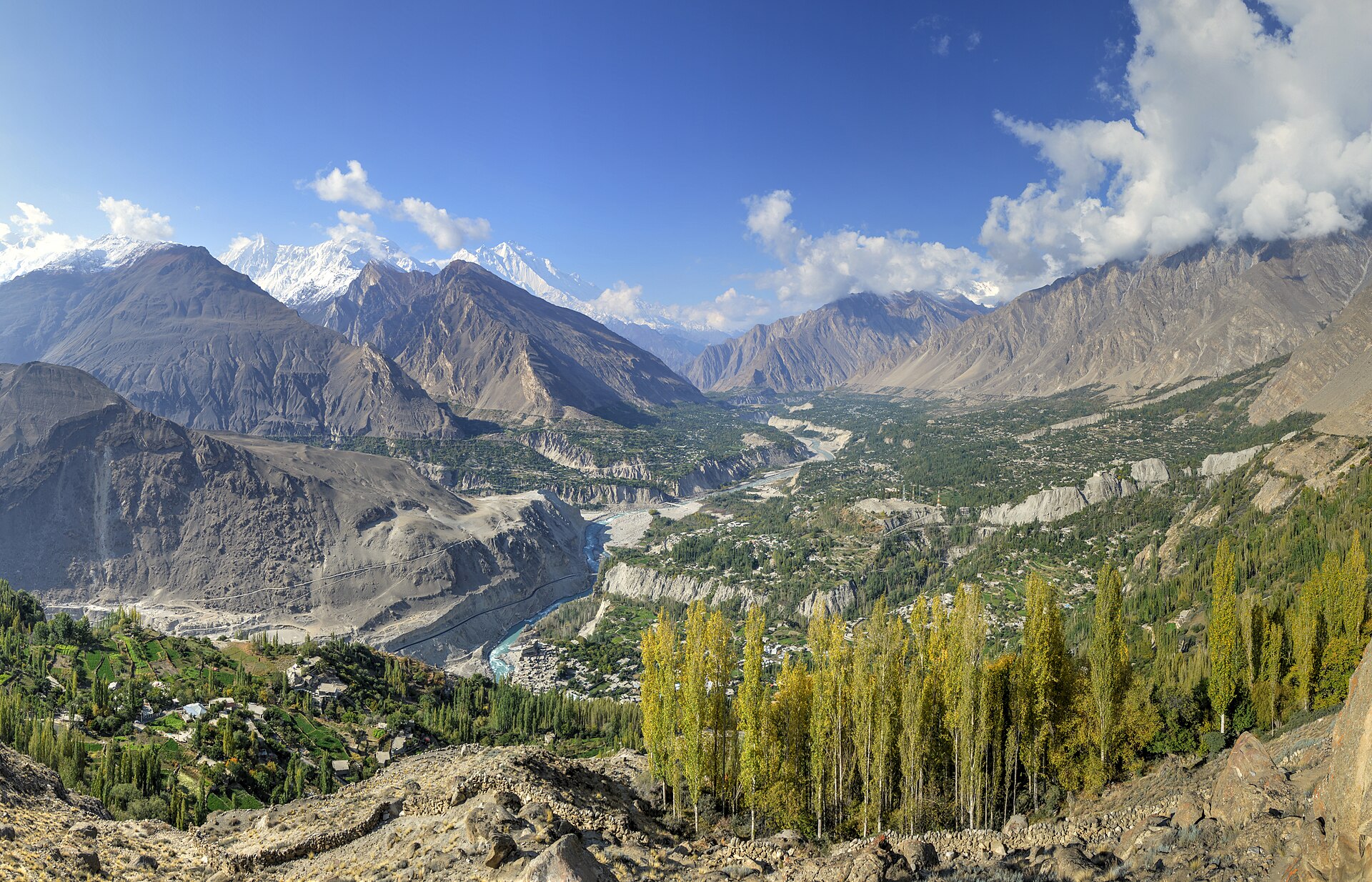
Pakistan is the country the world’s travel media have «discovered» in recent years, and the reason is in the north. In the Hunza valley apricot orchards stretch out between seven-thousand-metre peaks. The water of Attabad lake is turquoise. The Karakoram Highway and Skardu’s Deosai plateau are on that route too. In the south there are the Mughal mosques of Lahore and the most hospitable people in the world — everyone who goes says so, and everyone who goes is right. For us the visa is obtained online and there are direct flights from Baku to Islamabad, Lahore and Karachi. In this article I have gathered the cities, the northern route and the transport. The food, the season, the safety rules and the budget are in there too.
Pakistan in brief
| Capital | Islamabad; the largest cities are Karachi and Lahore |
| Language | Urdu and English; English works everywhere |
| Currency | Pakistani rupee (PKR), 1 dollar ≈ 280 rupees; cash is the basis, cards in the big cities |
| Visa | Online visa, with a fee; the free regime has ended, details in our visa article |
| Best time | The north April–October, the cities October–March |
| Flights | Baku–Islamabad, Lahore and Karachi direct, AZAL, 3.5–4 hours |
| Daily budget | 40–60 dollars at a mid-range level |
Islamabad and Lahore
Islamabad is a planned, green and quiet capital, and one day is enough. At the foot of the Margalla hills stands the Faisal Mosque, one of the largest mosques in the world. Daman-e-Koh is the viewpoint. The Pakistan Monument and the Lok Virsa museum are in the city, and in the village of Saidpur there are restaurants. Nearby lie the UNESCO-listed Buddhist ruins of Taxila and the Raja Bazaar of Rawalpindi.
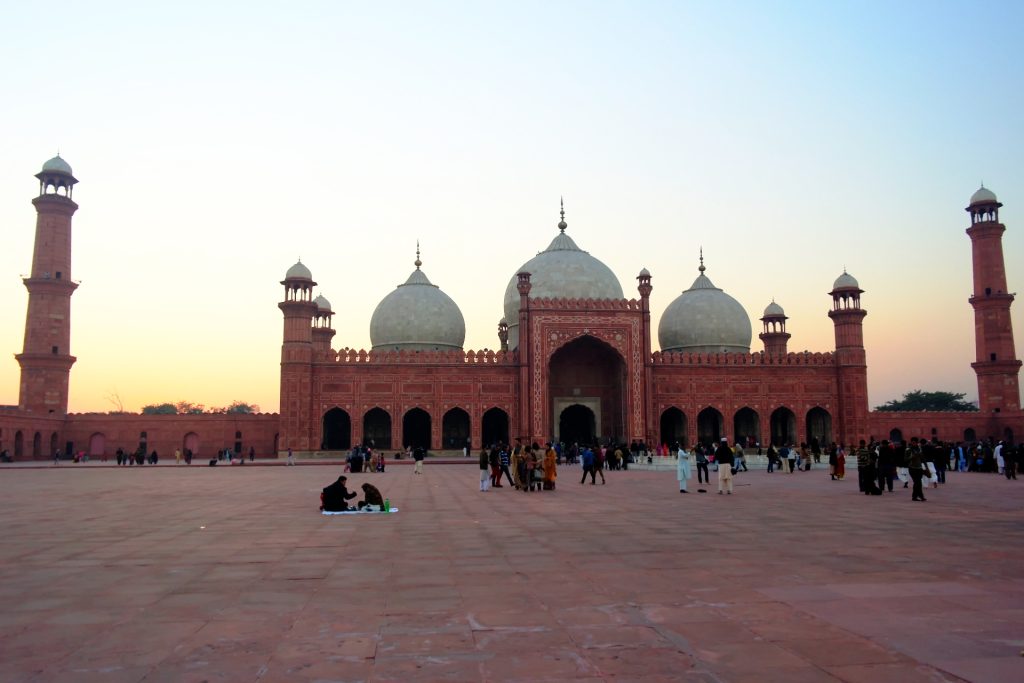
Lahore is Pakistan’s cultural capital and is four hours from Islamabad by car and an hour by plane. The Badshahi Mosque is the huge red mosque of the Mughal period, and a hundred thousand people fit into its courtyard. Lahore Fort and the Shalimar Gardens are on the UNESCO list, while the Delhi Gate of the walled city and the tilework of the Wazir Khan mosque must certainly be seen.
On Food Street you eat in the evening on terraces with a view of the mosque, and the Anarkali bazaar is nearby. At the Wagah border thirty kilometres away, a flag-lowering ceremony with India is held every evening. The two sides shout at each other, the spectators applaud, and it is the country’s most extraordinary show. Set aside two or three days for the city.
Karachi is a port megacity of twenty million and, with Clifton beach and the Mohatta Palace, is mostly visited for business trips.
Hunza, Skardu, Karakoram: the north of Pakistan
The north is the main reason for coming to Pakistan. The Hunza valley is at two and a half thousand metres in Gilgit-Baltistan and is the open, literate, tourist-friendly region of the Ismaili community. In Karimabad there are the Baltit and Altit forts and apricot orchards, and ahead stands the seven-thousand-seven-hundred-and-eighty-eight-metre peak of Rakaposhi. From the Eagle’s Nest viewpoint five seven-thousanders fit into one frame.
Attabad lake was formed by the landslide of 2010, its water is turquoise, and there are boats and jet skis on it. The Passu Cones and the Hussaini suspension bridge are here too, and on the bridge your legs shake. The Khunjerab Pass at four thousand seven hundred metres is the Chinese border and is considered the highest paved border crossing in the world. April is the time of blossom and October of golden autumn.
Skardu in Baltistan is the base for K2. The Shangrila resort is on Lower Kachura lake. The Deosai plateau is at 4100 metres and is called «the roof of the world»; it is open from July to September. Shigar fort, the Sarfaranga cold desert and Katpana are in this region too. The Karakoram Highway runs six hundred kilometres from Islamabad to Hunza and takes fourteen to eighteen hours. It is one of the most scenic and most difficult roads in the world. The 8126-metre wall of Nanga Parbat is visible from the road. The Fairy Meadows trek starts at its foot as well. The Naran-Kaghan and Swat valleys are a nearer alternative.
Transport in Pakistan: flights, the Karakoram Highway, Careem
The flight north with PIA from Islamabad to Skardu and Gilgit takes an hour and costs 60–100 dollars. It is one of the most beautiful flights in the world, with Nanga Parbat visible from the window, but it is often cancelled because of the weather, so plan a spare day or two.
Overland, NATCO buses and private companies go from Islamabad to Gilgit; the journey takes sixteen to twenty hours and costs 15–25 dollars, and travel is mostly at night. The alternative is a car with a driver: you go over two days taking in the scenery and pay 150–250 dollars, and that is what I recommend.
Between the cities, Daewoo and Faisal Movers buses go from Islamabad to Lahore in four and a half hours for 8–12 dollars, and they are both comfortable and punctual. Inside the cities a ride with Careem and inDrive costs 1–3 dollars, while in Lahore the metro bus and the Orange Line metro operate. Within Hunza a jeep with a driver is 40–60 dollars a day, and between the villages Suzuki minibuses run.
Know one more rule: some regions require an «NOC» permit for foreign nationals. Hunza and Skardu do not require it, while Azad Kashmir and the border zones do.
Nihari, karahi, chapli: Pakistani food and hospitality
Pakistani cooking is built on meat and spice, so be ready for the heat. Nihari is beef cooked all night and served for breakfast. Karahi is chicken or goat cooked with tomato in a wok-like pan and is the symbol of Lahore. The best biryani is in Karachi, chapli kebab is Peshawar’s flat patty, and seekh kebab is found everywhere.
For breakfast halwa puri is served too, with dal, tandoor naan and roti alongside. In Hunza there is apricot oil, a meat pie called chapshuro and dried apricots. Tea here is called «doodh patti» and is boiled with milk, with lassi and Multan halwa beside it.
Everything is halal and there is no alcohol. Street food is 1–2 dollars and lunch in a restaurant 3–6; dinner on Lahore’s Food Street is 10–15 dollars and home cooking at a Hunza guest house 3–5.
Let me say a separate word about the hospitality. Pakistanis invite a guest home, an offer of tea comes in every shop, and refusing it is difficult. «Mehman», that is the guest, is considered sacred here, and in a week you get to know ten families.
For your health drink only bottled water and avoid street ice. For women covered clothing matters, especially in the cities, while Hunza is freer.
Read next: The Pakistan visa after the free regime: applying online, the fee and the direct flights
Season and safety
The north is open from April to October. For Deosai and Khunjerab the only time is from June to September. April with apricot blossom and October with autumn colours give Hunza its loveliest moments. In winter the roads are snowy and the flights thin out.
In Lahore and Islamabad the weather stays at 15–25 degrees from October to March and rises to 40–45 from April to June. In July-August the monsoon starts, there is a flood risk and landslides occur on the Karakoram Highway.
As for safety, the tourist routes — that is Islamabad, Lahore, Hunza and Skardu — are quiet, and the police behave hospitably. Balochistan, the Afghan border regions of Khyber Pakhtunkhwa and some districts of Karachi are not for tourists, so look at the advice of Azerbaijan’s Ministry of Foreign Affairs.
The rules are simple. Travel with a local driver and guide, stay away from political events and carry a copy of your passport. Passport registration at checkpoints on the road is normal and takes ten minutes. Regional and permit information is on the Pakistan Tourism Authority portal.
Budget and tickets
In Islamabad and Lahore a three-star hotel is 30–50 dollars, while the five-star Pearl Continental rises to 120–200. In Hunza a guest house is 15–30 dollars and a boutique hotel with a view 50–100, and in Skardu it is 25–60. There are few hotels with a good view in Hunza, so take your place before the season.
Entry tickets are cheap. Lahore Fort is two dollars, Baltit fort four, the Attabad boat five and entry to Deosai ten. Excluding the flight, a ten-day trip including the northern route fits, with a driver, into 600–1000 dollars per person, and that is one of the cheapest mountain trips in the world.
AZAL flies direct from Baku to Islamabad, Lahore and Karachi, and PIA operates too; a ticket towards Islamabad should be bought early in summer. Northern Pakistan tour packages that give Hunza, Skardu and Lahore in one programme settle the driver, the guide, the domestic flight and the spare days together, and for a first trip that is the easiest and safest way.
Frequently asked questions about Pakistan
How many days does a trip to Pakistan need?
One day for Islamabad, two for Lahore, four for Hunza, three for Skardu plus the road — ten to twelve days in all. Lahore and Islamabad alone, four days.
Can a woman travel alone?
In Hunza and on the tourist routes women travellers are steadily more numerous and are met with respect. Covered clothing, a local guide and a group tour increase the comfort, and do not walk alone at night in the cities.
Can it be combined with India?
The Wagah crossing is in theory open to foreigners, but it closes often depending on the situation between the two countries. Planning two separate trips is more reliable, and each requires its own visa.
In closing
With direct flights, an online visa and very cheap prices, Pakistan gives you the world’s most magnificent mountain scenery and its warmest hospitality, and with the right route and a local driver the trip passes safely and unforgettably. The visa process is explained on the Pakistan page, and to build the Hunza and Skardu route together, fill in the application form.
Note: the prices here are as of the publication date; the regional situation must be checked before travelling.
