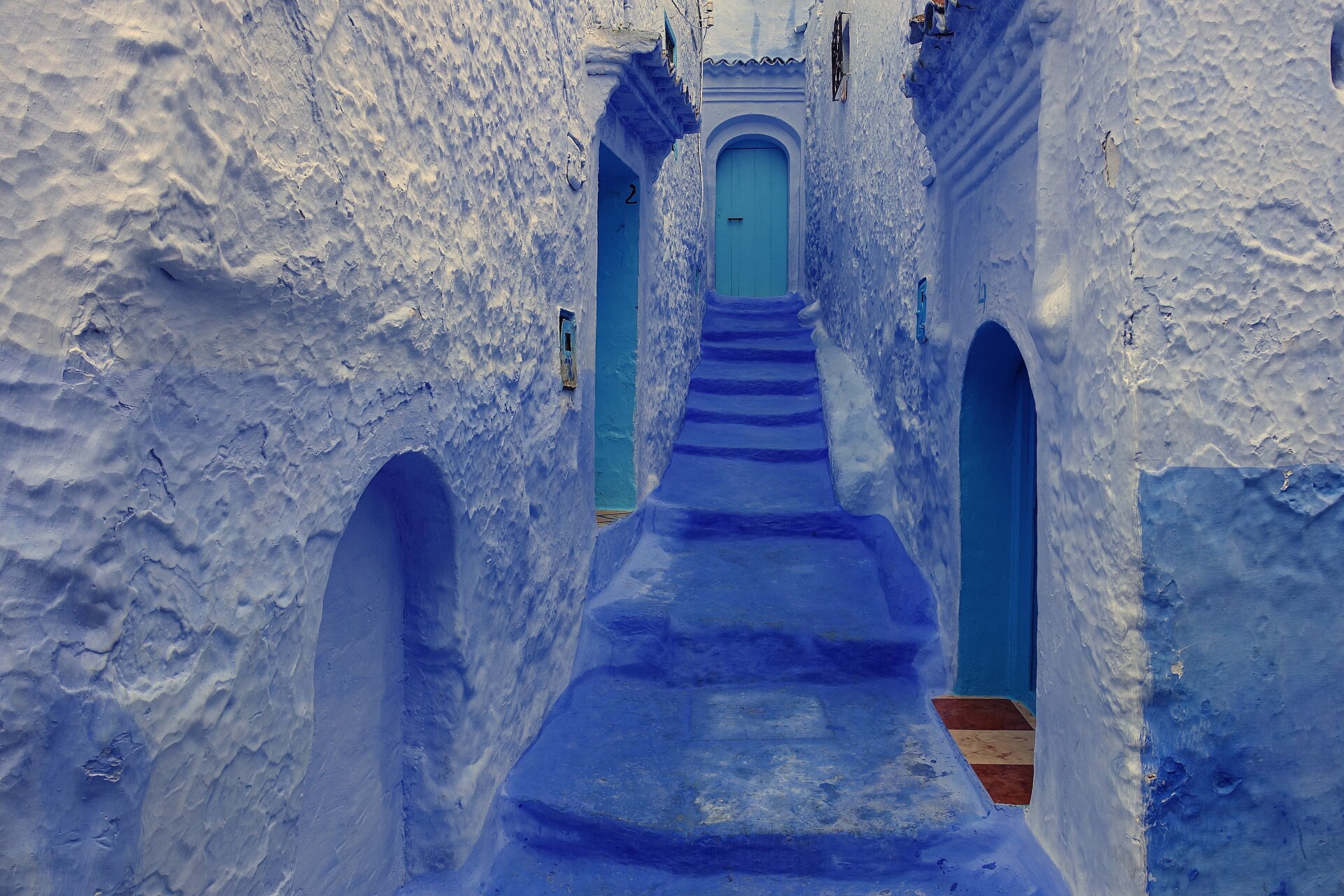
At Africa’s closest point to Europe, Morocco greets you with an Eastern fairy tale. On Marrakesh’s Jemaa el-Fnaa square the snake charmers perform, in Fez there is a medina like a labyrinth, and on the mountainside stands blue Chefchaouen. On the dunes of the Sahara a camel caravan and a starry night in a camp await you.
For us the visa has been abolished, you can stay in the country ninety days visa-free, and the flight via Istanbul is comfortable. The country is cheap, its food suits our palate and everything is halal. Below I have gathered the cities, the Sahara route, the trains and buses, the medina rules, the food, the hammam, the season and the budget in one place.
Morocco in brief
| Capital | Rabat; the largest city is Casablanca, the tourist centre Marrakesh |
| Language | Arabic and Berber; French everywhere, English in tourism |
| Currency | Dirham (MAD), 1 dollar ≈ 10 dirhams; cash in the market, cards in hotels and restaurants |
| Visa | 90 days visa-free for citizens of Azerbaijan |
| Best time | March–May and September–November; the Sahara October–April |
| Flight | 8–9 hours to Casablanca or Marrakesh via Istanbul |
| Daily budget | 50–80 dollars at a mid-range level |
Marrakesh, Fez, Chefchaouen: three medinas
Marrakesh is called “the red city” and is the country’s tourist capital. Jemaa el-Fnaa square, with its evening food stalls, musicians and storytellers, is on UNESCO’s intangible heritage list. The square, which looks empty at midday, turns into theatre in the full sense after six o’clock.
The souks of the medina are full of leather, spices and lamps. The Bahia Palace, the Ben Youssef madrasa and the Koutoubia minaret are must-sees, the Majorelle Garden and the Yves Saint Laurent museum are on the list too, and you should buy tickets for those online. Stay in a riad in the city, that is, a traditional house with a courtyard, because that is the medina experience itself. Set aside three days.
Fez is the largest car-free city in the world and there are nine thousand streets in its medina. The Chouara tanneries are famous for their coloured vats, and at the entrance they hand you a bunch of mint because of the smell. Al-Qarawiyyin is the oldest university in the world, and the Bou Inania madrasa stands nearby. Do go with a guide, or you will be lost for hours. Set aside two days. Chefchaouen is a town in the Rif mountains painted entirely blue. It has narrow stepped streets and is very quiet. Go out early in the morning for photographs. It is four hours from Fez; set aside a day or two. Rabat is the quiet capital, with the Hassan Tower and the Kasbah of the Udayas, while Meknes and the Roman ruins of Volubilis are a day trip near Fez.
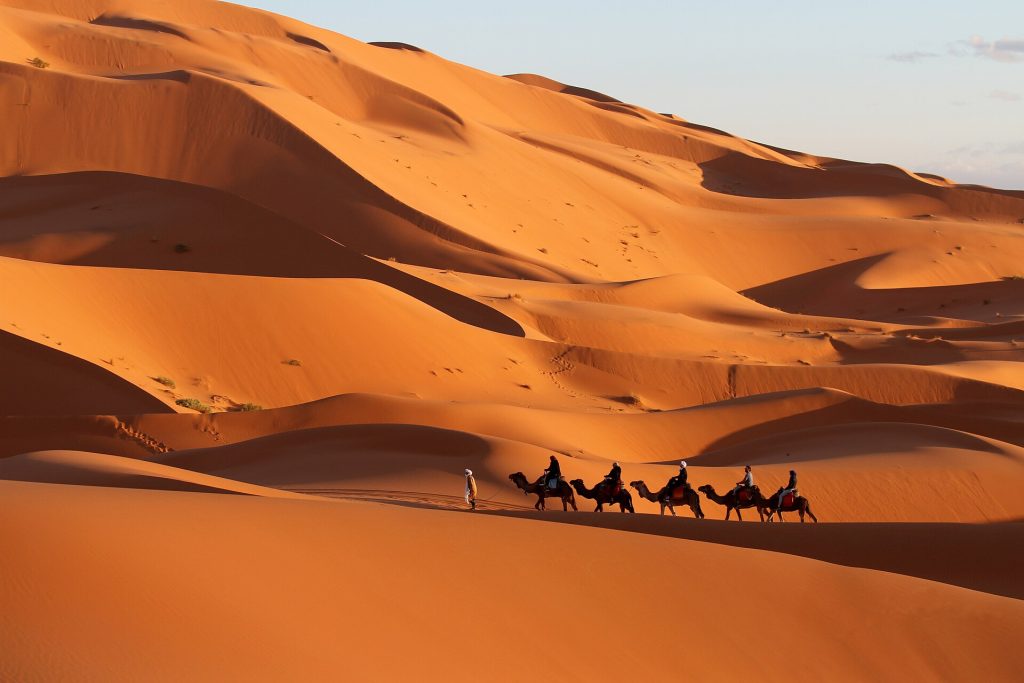
The Sahara, the Atlas, Essaouira, Casablanca: Morocco outside the cities
The Sahara trip is a classic three-day route out of Marrakesh. Over the High Atlas by the Tizi n’Tichka pass you go to the ksar of Ait Ben Haddou, where Gladiator and Game of Thrones were filmed. Ouarzazate has film studios. On the way you pass the Dades and Todra gorges. At Merzouga the Erg Chebbi dunes begin and you ride out to the sunset by camel. At the Bedouin camp there is dinner and Berber music, and in the morning you watch the sunrise. That night stays with you for life. A group tour to the desert is 100–150 dollars and a private one 300–500, and afterwards you can continue to Fez. Choose Merzouga programmes after reading the reviews, because the standard of the camps varies enormously.
In the High Atlas the village of Imlil is the base for Toubkal, the highest peak in North Africa. The summit is four thousand one hundred and sixty-seven metres and people climb it on a two-day hike. If you are short of time, take a day trip to the villages: the road from Marrakesh takes an hour and a half, and the Ourika valley takes half a day.
Essaouira is a windy port town on the Atlantic coast. The blue boats and the ramparts are the town’s symbol, while the trace of Jimi Hendrix and the kitesurfing are a reason to come in themselves. It is three hours from Marrakesh; set aside a day or two.
In Casablanca the Hassan II mosque rising above the sea is open to non-Muslims too, and with the Art Deco centre the city takes half a day. Agadir is a beach resort in the south, and Tangier a port in the north looking across at Europe.
Transport in Morocco: Al Boraq, CTM, the petit taxi
Al Boraq is Africa’s first high-speed train, running from Tangier to Casablanca in two hours for 15–25 dollars. ONCF trains take two and a half hours from Casablanca to Marrakesh and three and a half to Fez, cost 10–15 dollars, and first class is comfortable.
CTM and Supratours buses take you to the places the trains do not reach, such as Chefchaouen, Essaouira and Merzouga. From Fez to Chefchaouen the road takes four hours and costs eight dollars, and you should buy the tickets online.
Inside the cities the small metered taxis called “petit taxi” charge 2–4 dollars, and you must insist on the meter. A “grand taxi” is a shared intercity Mercedes, while Careem and inDrive work in Marrakesh and Casablanca.
A car is needed for the Atlas and the Sahara, with daily rental at 25–40 dollars. The roads are good, the mountain roads are switchbacks, and cars do not go into the medinas at all. A taxi from Marrakesh airport to the medina is 10–15 dollars and bus number nineteen three dollars. Getting lost in the medina is normal, so keep an offline map and the riad’s phone number in your pocket.
Tagine, couscous, hammam: Moroccan food and culture
A tagine is meat, chicken or vegetables cooked slowly in a clay pot with a conical lid, served with prunes and almonds. It is on every table in the country and comes to 3–6 dollars. Couscous, meanwhile, is the Friday family meal.
Pastilla is a sweet-and-savoury chicken pie, harira is the Ramadan soup, and mechoui is roast lamb. Msemen is the breakfast bread and is eaten with honey. Mint tea is the ritual of every meeting and they pour it from a height, while orange juice on Jemaa el-Fnaa costs fifty cents.
Everything is halal. Street food is 2–3 dollars, lunch in a medina restaurant 6–10, dinner on a riad terrace 15–25, while in the modern restaurants of Marrakesh’s Gueliz district the bill climbs to 25–40 dollars.
The hammam is the foundation of Moroccan culture. A neighbourhood hammam is 2–3 dollars with a scrubbing mitt and black soap, a tourist spa hammam 30–60 dollars with an argan oil massage, and most riads have their own. Tap water is drunk in the cities, but bottled water is easier. In the market the price halves through bargaining, nobody buys at the first price named, and “la, shukran” is the polite refusal.
Read next: The Morocco visa has been abolished: 90 days visa-free, the border rules and the route via Istanbul
The season and the medina rules
March–May and September–November are the ideal months, the weather in Marrakesh is 22–30 degrees and the Sahara nights are cool.
From June to August the temperature in Marrakesh and Fez climbs to 40–45 degrees and in Merzouga it becomes unbearable. In those months the coast, that is Essaouira and Agadir, stays comfortable at twenty-five degrees.
From December to February it is eighteen degrees by day and five at night. Heating in the riads is weak, so ask for an extra blanket. The Sahara is ideal in winter, snow falls in the Atlas and the Oukaimeden ski centre operates. During Ramadan the restaurants are closed during the day and the city comes alive in the evening.
The medina rules go like this. Say no to the people who present themselves as guides saying “it’s closed, let me take you” — nothing is closed. Some people ask for money for photographs, an invitation to a “free terrace” at the tanneries ends in shopping, women get around more comfortably in covered clothes, and on Jemaa el-Fnaa in the evening watch your pocket. The country is safe overall and there is tourist police in every medina. Regional and event information is on the Visit Morocco portal.
Budget and tickets
In Marrakesh a riad costs 40–80 dollars and a luxury riad 120–250. In Fez the price is 35–70 dollars, and in Chefchaouen a guesthouse 25–45. A Sahara camp including meals is 40–80 dollars, while a luxury camp starts at 150.
Entry tickets are cheap. The Bahia Palace charges seven dollars, the Majorelle Garden seventeen and the Ben Youssef madrasa five, while a hammam ranges from 3 to 40 dollars. Leaving out the flight, a ten-day trip fits into 600–900 dollars a head, and that makes it one of the best-value trips in all of Africa.
Turkish Airlines flies from Istanbul to Casablanca and Marrakesh, and Qatar Airways to Casablanca via Doha. An air ticket to Marrakesh gets dearer at Novruz and in the autumn holidays, while flying to Casablanca and continuing by train sometimes works out cheaper. Morocco tour packages that fit Marrakesh, the Sahara and Fez into a week settle the desert camp, the driver and the riad bookings together.
Frequently asked questions about Morocco
How many days do you need for a Morocco trip?
Three days for Marrakesh, three for the Sahara, two for Fez, one or two for Chefchaouen: ten in all. With only Marrakesh and Essaouira, five days.
Is a Sahara camp possible with a child?
Yes, children over five love the camels and the dunes, and the camps have family tents. The length of the road is the main difficulty: nine hours from Marrakesh, which you can cut to seven by flying to Fez.
Is it hard without French?
No, English works in tourism, and in the market numbers and a calculator do the job. In Arabic, “shukran” and “la” are enough.
In closing
Morocco is visa-free, cheap, halal and a country that fits four different worlds — the medina, the mountains, the desert and the ocean — into one week; for anyone who knows the medina rules it is one of the most colourful trips there is. The entry rules are gathered on the Morocco page, and to build the Sahara and medina route together fill in the application form.
Note: the prices here are as of the publication date and can change with the season.
