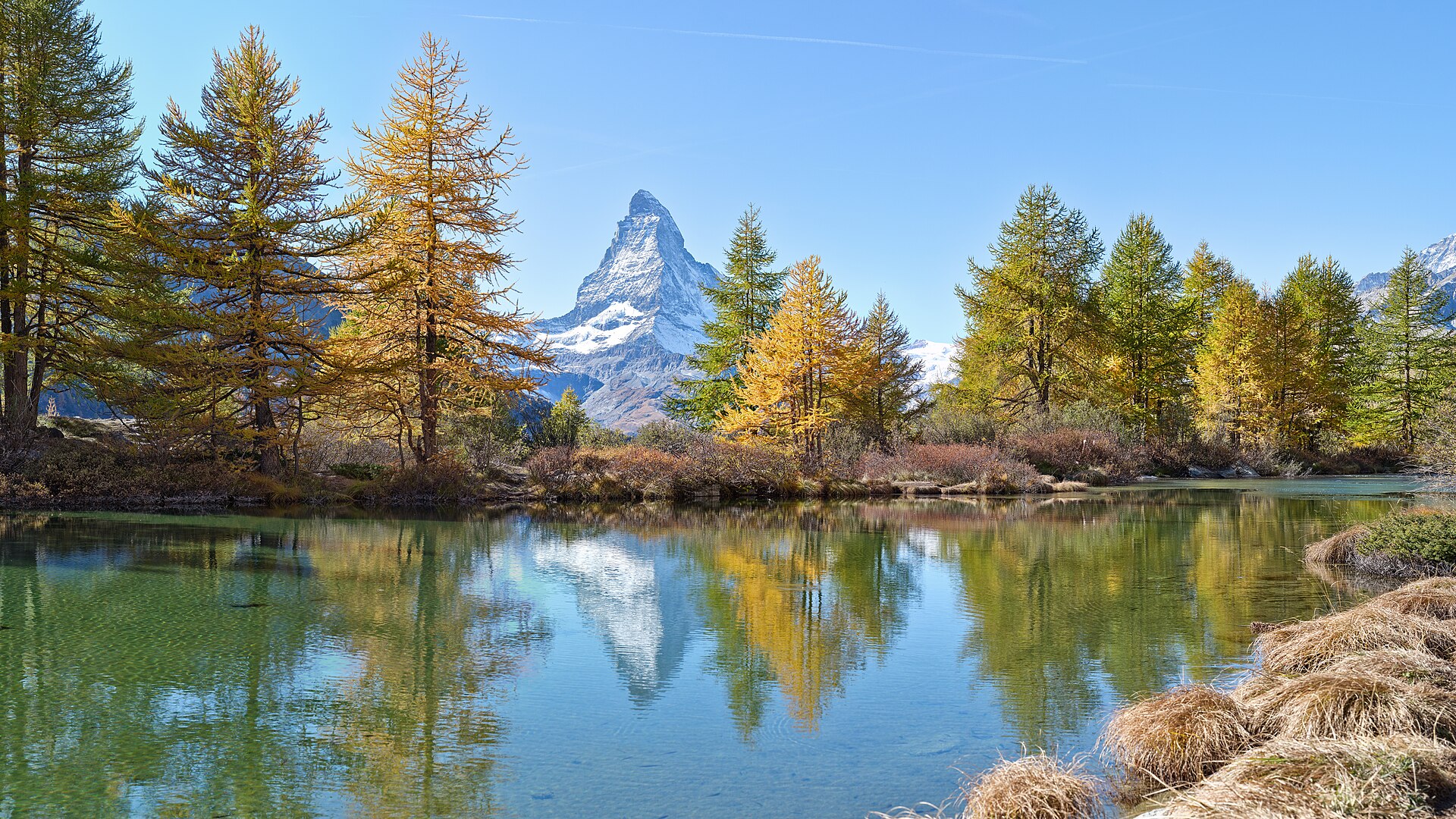
Switzerland means mountains, lakes and trains. The pyramid of the Matterhorn and the railway climbing to the Jungfrau are the country’s calling card. Lucerne’s wooden bridge and the vineyards on the shore of Lake Geneva are on the list too. For us the visa comes straight from the embassy, and the same visa covers Liechtenstein. The main issue is money: this is one of the world’s most expensive countries, and anyone going without a plan spends in a week what France and Italy would cost together — I have seen it with my own eyes. In this article I have gathered the cities, the Alpine resorts and the Swiss Travel Pass arithmetic. The scenic trains, the food, the thermal spas, the season and the budget are in there too.
Switzerland in brief
| Capital | Bern; the largest cities are Zurich and Geneva |
| Language | German, French, Italian and Romansh; English everywhere |
| Currency | Swiss franc (CHF), 1 franc ≈ 1.05 euros; cards everywhere, euros in some places at a poor rate |
| Visa | Schengen «C» visa, directly at the Swiss embassy in Baku |
| Best time | June–September for walking; December–March for skiing |
| Flights | 7–8 hours to Zurich or Geneva via Istanbul |
| Daily budget | 250–350 francs at a mid-range level |
Swiss cities: Zurich, Lucerne, Bern, Geneva
Zurich is the gateway. The old town, the Bahnhofstrasse shopping street and the lakeside are walked in a day, and in summer you see people swimming in the river that runs through the middle of the city.
Lucerne is the country’s loveliest town. The fourteenth-century wooden Kapellbrücke and the lake are at its centre. The world’s steepest cogwheel railway climbs Mount Pilatus, and you reach Mount Rigi by a boat-and-train combination. Set aside two days.
Bern is the capital. With its old town on the UNESCO list, six kilometres of arcades and the green river Aare, it takes half a day.
Geneva, with the 140-metre fountain on the lake, the UN and the Red Cross museum, is the centre of the French-speaking west. Nearby Lausanne is known for the Olympic museum. Montreux is remembered for its jazz festival and the Château de Chillon. The Lavaux vineyard terraces are a day’s outing, and walking the terraces looking out over the lake costs nothing. Lugano in the south is an Italian-spirited lake town, and Basel on the Rhine is known for its art museums.
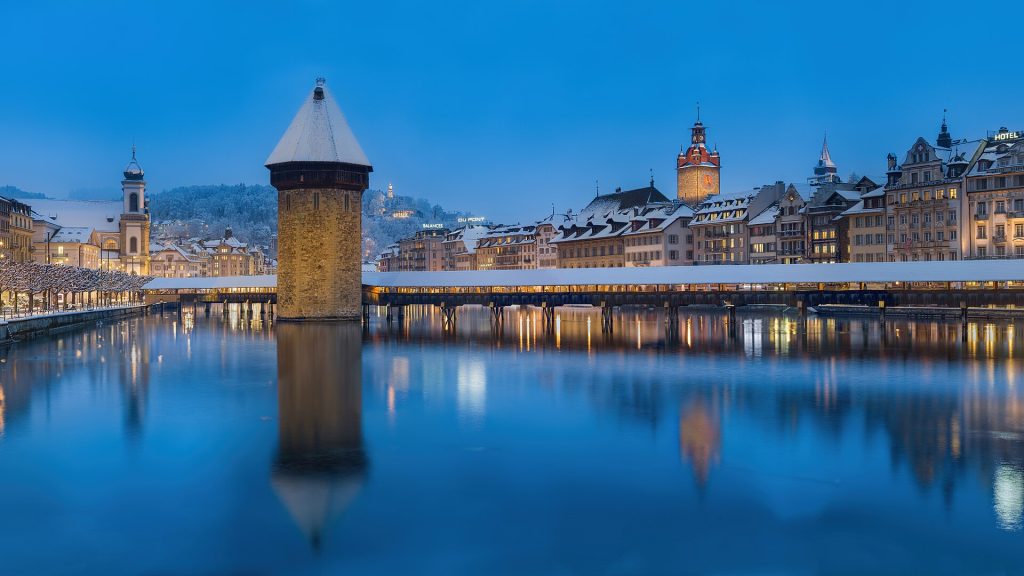
The Alps: Interlaken, the Jungfrau, Zermatt
Interlaken, between two lakes, is the base of the Bernese Alps. In the Lauterbrunnen valley there are seventy-two waterfalls, the car-free villages of Wengen and Mürren, and cable cars to Grindelwald and the First peak. Jungfraujoch is called «the top of Europe» and is a railway station at 3454 metres. The return trip costs more than two hundred francs, with a discount on the Swiss Travel Pass. Harder Kulm above Interlaken is the cheap alternative view, and honestly, plenty of people are perfectly happy with that.
Zermatt is a car-free village at the foot of the Matterhorn’s 4478-metre pyramid, and the mountain is visible from every street. There is the Gornergrat cogwheel train and the Matterhorn Glacier Paradise cable car, the peak’s reflection in Lake Riffelsee, and in winter the highest ski area in the Alps. St Moritz is a luxury winter resort in the Engadine valley. In the mountain villages the walking trails are marked with yellow signs and are free — in an expensive country that is the best budget activity there is.
Swiss trains and the Swiss Travel Pass sum
SBB trains reach every village with clockwork precision. Boarding without a ticket means a straight fine; the inspector makes no allowances.
The Swiss Travel Pass is bought for three, four, six, eight or fifteen days. It makes all trains, buses, boats and city transport free, plus more than five hundred museums. Some mountain trains are free and the rest are fifty per cent off; three days in second class is 244 francs.
The sum is simple. If you are planning two mountain peaks and three intercity journeys, the pass pays for itself; if you are staying in one city, do not buy it. The Half Fare Card, at 120 francs a month, halves every ticket and pays off for anyone staying more than eight days.
The scenic trains are an event in themselves. The Glacier Express runs eight hours from Zermatt to St Moritz, crossing 291 bridges and 91 tunnels on the way. The Bernina Express is a UNESCO line running from the Alps into Italy. And the GoldenPass runs from Montreux to Lucerne. A car is needed only for the remote valleys, and the motorway vignette is 40 francs.
Fondue, rösti and the thermal spas
Fondue is dipping bread into melted cheese, and raclette cheese is melted over potatoes. Both are winter classics, and ordering them in summer makes the waiter smile.
Rösti is fried potato, Zurich-style veal comes in a cream sauce, and the Engadine nut tart is the dessert. There is also the world’s best chocolate and four hundred and fifty kinds of cheese.
Lunch in a restaurant is 25–35 francs and dinner 50–80. The budget is saved by the Coop and Migros supermarkets, their own restaurants and the station cafés, where lunch comes to 12–18 francs. Halal food is available in the Turkish and Balkan restaurants of Zurich, Geneva and Basel. Tap water and the water from the city fountains are drinkable — do not pay for bottled.
The thermal spas are Switzerland’s least talked-about side. Leukerbad is the largest thermal resort in the Alps, with 51-degree water that people come to for joints and rheumatism, and Bad Ragaz is a luxury spa. Sitting in Leukerbad’s open pool looking at the snowy mountains is the finest winter experience there is.
Read next: Switzerland visa: applying directly at the embassy, the financial requirement and Liechtenstein
Season and weather
June to September is the mountain season. The trails are clear of snow, the cable cars run, the cities are 20–25 degrees and the peaks 5–10. July and August are the busiest and most expensive, while September is the best month, because the weather settles and the crowds thin.
December to March is the ski season, and Zermatt and St Moritz are at their most expensive at the end of December and in February.
April–May and October–November are the «dead season»: many mountain hotels and cable cars are closed, but the cities get cheaper in exchange. In the mountains the weather changes by the hour, so take a jacket even in summer. Swiss Travel Pass and cable car timetables are on the MySwitzerland portal.
Budget and tickets
A three-star hotel is 180–260 francs in Zurich, 150–220 in Interlaken and 200–350 in Zermatt. An apartment in a mountain village comes to 120–180. A hostel bed is 50–70 francs and is the one option that saves a budget in Switzerland.
The peaks are expensive. Jungfraujoch is 220 francs, Gornergrat 130 and Pilatus 80, with the Swiss Travel Pass bringing the price down 25–50 per cent. Excluding the flight, a week-long trip fits into 2200–3000 francs per person, which is the most expensive in all of Europe.
Turkish Airlines flies to Zurich and Geneva via Istanbul. Alongside a ticket to Zurich, flying to Milan and coming to Lucerne on a three-and-a-half-hour train often works out cheaper. Swiss Alps tour packages fitting Lucerne, Interlaken and Zermatt into one week settle the Swiss Travel Pass and the mountain tickets in advance.
Frequently asked questions about Switzerland
How many days does Switzerland need?
Lucerne two, Interlaken two or three, Zermatt two — a week in all. Ten days with Lake Geneva and the Glacier Express.
Can you cross to Italy and France on a Swiss visa?
Yes, it is a Schengen visa. Milan is three and a half hours from Lucerne and Lyon two from Geneva; the visa is taken from the main country of the trip.
How do you travel most cheaply?
Buy the Swiss Travel Pass and eat from the supermarket. Fountain water is drinkable and the walking trails are free. For accommodation, choose an apartment in a mountain village. And instead of Jungfraujoch, take First or Harder Kulm.
In closing
Switzerland is the world’s most expensive country, but it gives the most precise and most scenic trip there is. With the Swiss Travel Pass, the month of September and the supermarket rule, the budget can be managed. The visa process is explained on the Switzerland page, and to build the Alpine route together, fill in the application form.
Note: the prices here are as of the publication date and can change with the season.
