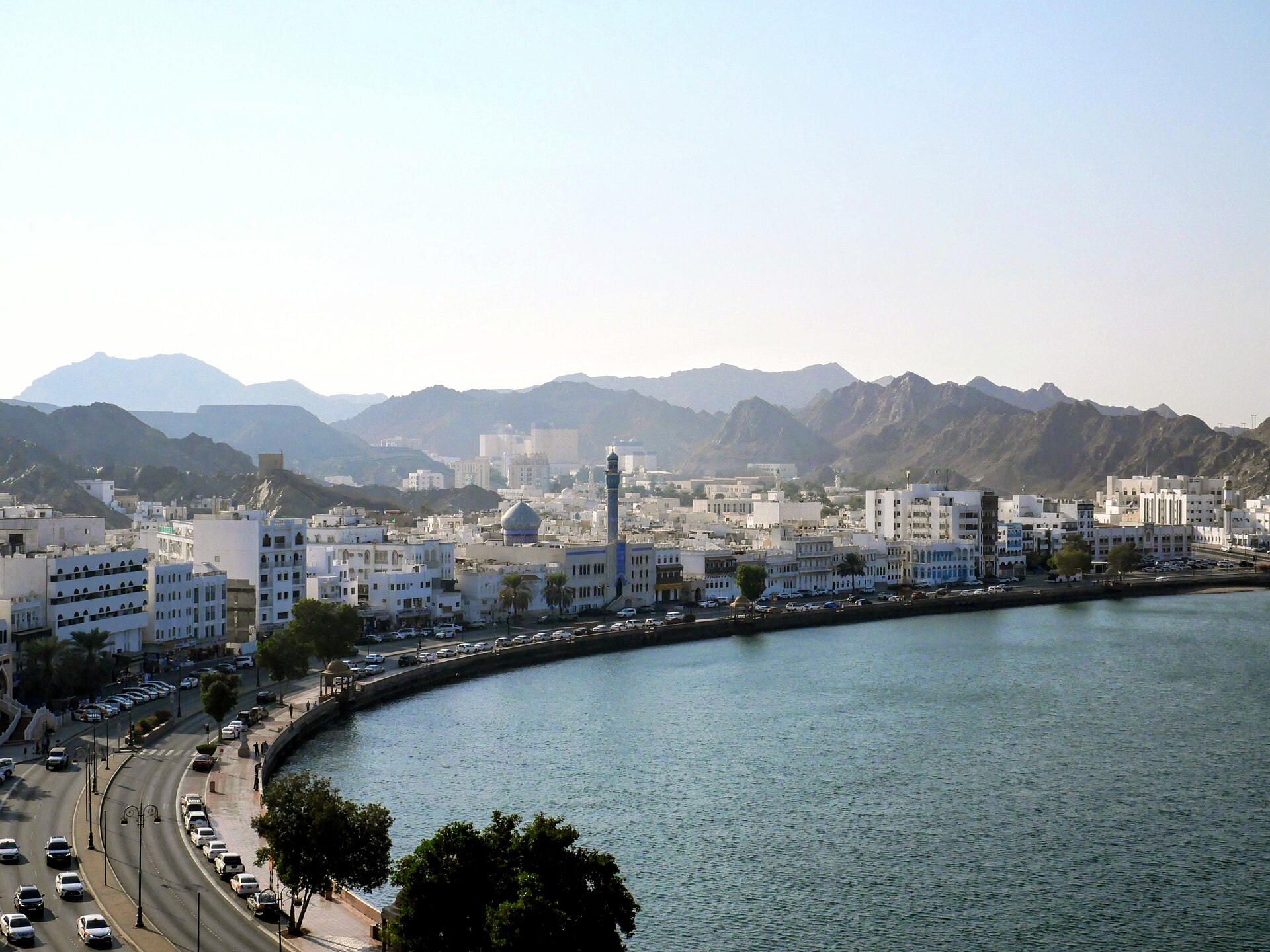
Oman is the most original country in the Gulf. Instead of Dubai’s skyscrapers there are white mosques and forts here, three-thousand-metre mountains, turquoise wadis, red desert and three thousand kilometres of coast. The country is among the safest in the world, and its people count as the friendliest in the Arab world: if your car breaks down on the road, the first person to pass stops and helps.
For us the eVisa is obtained online in three days, and SalamAir flies direct from Baku to Muscat. Oman is a country you tour by car and it needs serious planning. Below I have gathered Muscat, Nizwa and the mountains, the Wahiba desert, the wadis, Salalah, the driving rules, the food, the season and the budget in one place.
Oman in brief
| Capital | Muscat |
| Language | Arabic; English works everywhere |
| Currency | Omani rial (OMR), 1 rial ≈ 2.6 dollars; cards in the city, cash in the desert and the villages |
| Visa | eVisa online: 10 days 5 rials, 30 days 20 rials |
| Best time | October–April; Salalah July–September, monsoon |
| Flight | Baku–Muscat direct, SalamAir, 3.5 hours |
| Daily budget | 40–60 rials at a mid-range level |
Muscat: the mosque, Mutrah, the Corniche
Muscat is a low white city stretching fifty kilometres. There are no skyscrapers here, because they are forbidden by law, and that is precisely why the city is beautiful.
The Sultan Qaboos Grand Mosque is known for the world’s largest hand-woven carpet and its eight-tonne chandelier. It is open to non-Muslims from eight to eleven in the morning, entry is free, and clothing must be covered.
The Mutrah Corniche is a promenade along the harbour shore. The Mutrah souq beside it is the best address for frankincense, silver and the Omani dagger; go there in the evening, because during the day it is both hot and closed.
In Old Muscat there are the Al Alam palace and two Portuguese forts, with the National Museum nearby. The Royal Opera House is the first opera building in the Arab world. Qurum beach and Shatti Al Qurum are the seaside part. A dolphin tour by boat from Muscat is 15 rials, and at the Daymaniyat Islands you snorkel. The morning departures catch a calm sea, so book your place in advance. The city takes a day and a half to two days, and then you drive inland. The Bimmah sinkhole and Wadi Shab are an hour and a half along the road to Sur.
Nizwa, the mountains, Wahiba, the wadis: the classic Oman loop
The classic route starts in Muscat, comes back to it and takes five or six days.
Nizwa is the former capital, known for its round fort and its souq. On Friday morning the goat market is held here: the sellers walk a goat round in their arms while the buyers watch from the side and call out prices. Nearby are Bahla fort, on the UNESCO list, and Jabrin castle.
Jebel Akhdar, the “Green Mountain”, is at two thousand metres, with terraced villages and the rose water season in April and May, and the air stays cool. Only 4x4s are allowed up; the police check at the bottom and turn saloon cars back.
Jebel Shams reaches three thousand metres. The cliff of Wadi Ghul, counted as “the Grand Canyon of Arabia”, is a thousand metres deep, the Balcony Walk takes three hours, and you spend the night at a mountain camp.
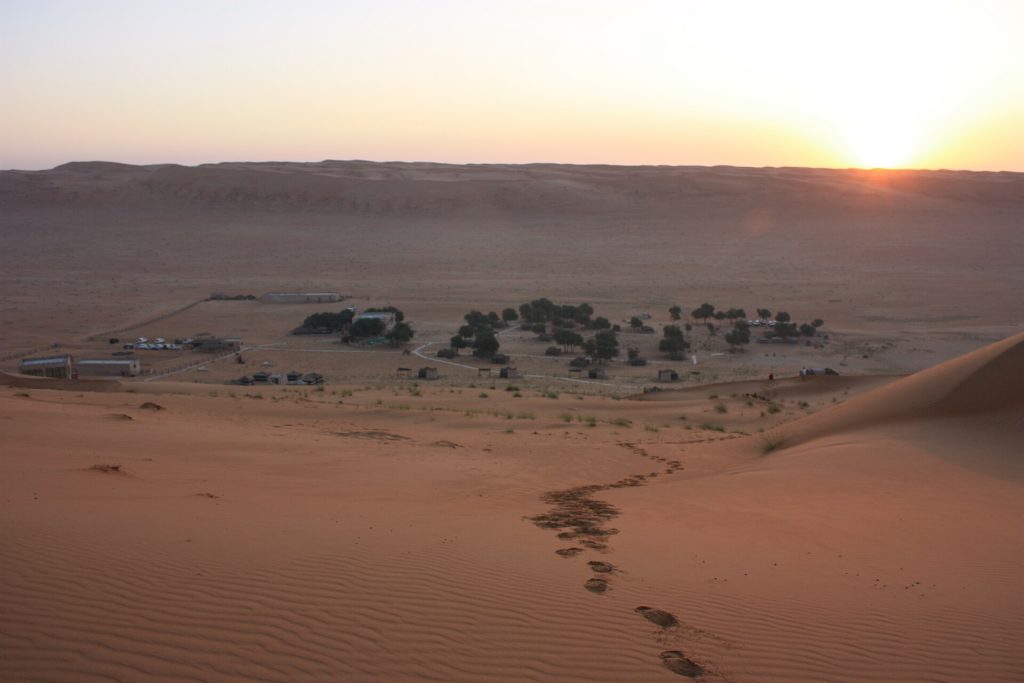
The Wahiba desert, officially the “Sharqiya Sands”, consists of two hundred kilometres of red dunes. You spend a night at a Bedouin camp, the programme includes dune bashing, a camel ride and a starry sky, and the price is between 25 and 60 rials.
Wadi Bani Khalid means turquoise pools among palm trees. Wadi Shab, meanwhile, ends after a forty-five-minute walk with a swim to a waterfall inside a cave and is Oman’s most famous experience. In the town of Sur the dhow shipyard is still working, and at Ras Al Jinz you watch green turtles laying their eggs at night.
Salalah is in the south, a thousand kilometres away. From July to September, when the “khareef” monsoon comes, the mountains turn green and waterfalls run, and the frankincense trees are there too. This is the Gulf’s only green summer, and the flight from Muscat takes an hour and a half.
Transport in Oman: the car is everything
Oman cannot be toured without a car. Public transport is limited to a few intercity Mwasalat bus lines; Muscat to Nizwa takes two hours and costs two rials, while the night bus to Salalah takes twelve hours.
A rental saloon is 12–18 rials a day, and the 4×4 needed for Jebel Akhdar, Jebel Shams and the desert 25–40. Fuel is among the cheapest in the world, the roads are excellent, the signs are in English, and the speed cameras are everywhere. Along with your Azerbaijani licence take an international one.
Do not drive into the desert in your own car; you will sink at the first dune, and the camp picks you up from the tarmac anyway.
In Muscat the Otaxi and Careem apps work, a ride across the city is 2–4 rials and from the airport to Mutrah 8–10. Street taxis have no meter, so agree the price in advance. A tour car with a driver is 60–100 rials a day and is the most comfortable option for families. The Musandam peninsula, that is the fjords of Khasab, is reached overland through the UAE and counts as a separate entry.
Shuwa, machboos, halwa: Omani food and the rules
Shuwa is lamb wrapped in banana leaves and cooked for two days in an earth oven, and it is a feast dish. Machboos is spiced rice served with chicken or fish and is the basis of the everyday table. Mashuai is grilled fish, and Omani halwa is made with saffron and nuts.
Dates and cardamom coffee are the ritual of every welcome and cannot be refused. On the coast there is kingfish, and in Salalah coconut and banana. Everything is halal.
As for prices, in Muscat the Indian, Pakistani and local restaurants around the Mutrah souq and in the Ruwi district charge 2–4 rials, while the international restaurants in the Qurum district charge 8–15. At the mountain and desert camps food is included in the package. Do not drink the tap water.
The rules are the Gulf’s strict ones, but applied calmly. Shoulders and knees must be covered in public places, and you enter a mosque with long sleeves. Alcohol is served only in hotel bars. During Ramadan you may not eat in the open during the day. Do not photograph people without permission. And on Friday morning everything opens late.
Read next: An Oman visa online in 3 days: 5 rials, 20 rials and the trap in the “visa-free” news
Season and weather
October to April are the ideal months. In Muscat the weather is 25–30 degrees and in the mountains 15–20, while in the desert it drops to ten at night, so take something warm. December to February and the Novruz week are the busiest and most expensive period.
From May to September the temperature in Muscat climbs to 40–45 degrees and the humidity rises; only Jebel Akhdar stays cool, while hotels drop to half price. Salalah in exactly those months gives you 25 degrees, mist and greenery with the “khareef” monsoon, and fills with tourists from the Gulf countries.
Take one danger seriously. There is a risk of flash floods in the wadis; when a rain warning is given do not go in, as people are lost for this reason every year. Information on the wadis, the forts and events is on the Experience Oman portal.
Budget and tickets
In Muscat a three-star hotel is 25–40 rials, a four-star 40–70 and the coastal resorts 80–150. In Nizwa the price is 20–35 rials, and in the Jebel Akhdar hotels 60–200. A desert camp with meals is 30–60 rials and a mountain camp 20–35.
The sights are cheap. Nizwa fort is five rials, the Wadi Shab boat one, the turtle tour eight, and entry to the Grand Mosque is free. Leaving out the flight, a week’s trip by car fits into 300–500 rials a head, that is 800–1300 dollars, which is cheaper than Dubai.
SalamAir flies direct from Baku to Muscat, while Qatar Airways and flydubai go with a connection. An air ticket to Muscat should be bought early for the winter holidays. Oman tour packages fitting Muscat, Nizwa, Jebel Shams and Wahiba into one week settle the 4×4 driver, the camp and the wadi bookings together, and combining the route with Dubai is possible as well.
Frequently asked questions about Oman
How many days do you need for an Oman trip?
Two days for Muscat, two for Nizwa and the mountains, two for the desert and the wadis: one week in all. With Salalah, ten days.
Can it be combined with Dubai?
Yes, the flight from Dubai to Muscat is an hour and the overland Hatta crossing five hours. For a border crossing in a rental car you need permission from the company; the UAE is visa-free and Oman is on an eVisa.
Which route with a child?
Stay at a beach hotel in Muscat and go out on a dolphin tour. The shallow pools of Wadi Bani Khalid are ideal for children. The desert camp and the turtle beach make the list too. The Jebel Shams cliff and the swim at Wadi Shab are for older children.
In closing
With a direct flight, an easy eVisa and some of the safest roads in the world, Oman is a country that gives you desert, mountains and sea in one week. The choice of car and season is what decides the trip. The eVisa rules are explained on the Oman page, and to build the circular route together fill in the application form.
Note: the prices here are as of the publication date and can change with the season.
