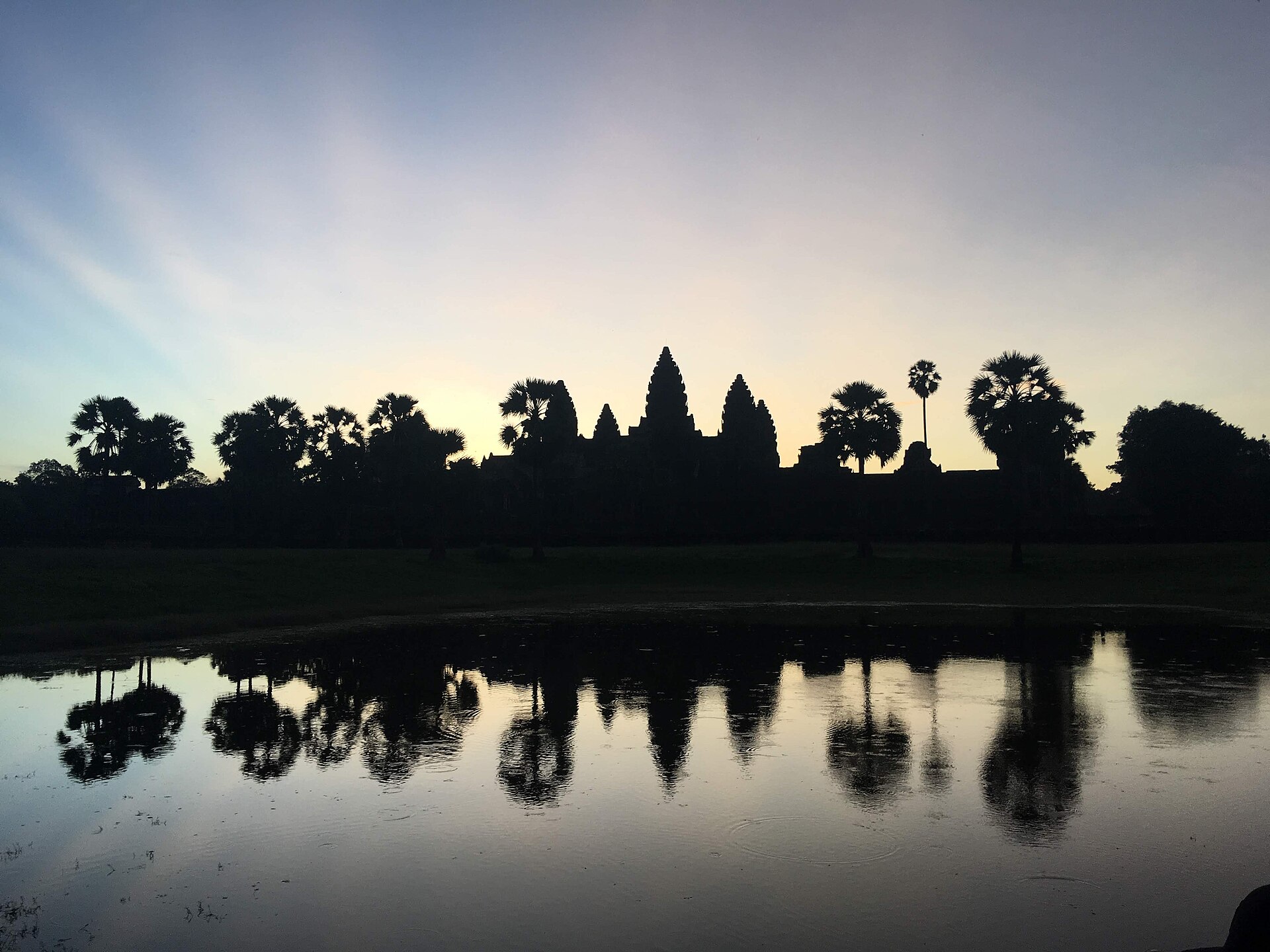
Cambodia is a country you go to for one temple, and that temple is worth it. Angkor Wat is the largest religious building in the world, and standing in front of it at sunrise is one of the most powerful moments in South-East Asia; in that instant you understand why you got up at five in the dark. But Cambodia is not only Angkor. There are also the heavy history of Phnom Penh, the pepper plantations of Kampot and the empty beaches of Koh Rong. For us the eVisa comes through in a few days, the country works in dollars and it is cheaper than Thailand. In this article I have gathered Angkor, the cities and the islands in one place. Transport, food, the season, safety and the budget are here too.
Cambodia in brief
| Capital | Phnom Penh; the tourist centre is Siem Reap |
| Language | Khmer; English works in tourism |
| Currency | US dollars everywhere, small change in riel, 1 dollar ≈ 4100 riel |
| Visa | eVisa online 36 dollars or on arrival 30 dollars, 30 days |
| Best time | November–February dry and cool; March–May very hot |
| Flight | 12–15 hours via Doha, Bangkok or Ho Chi Minh City |
| Daily budget | 40–60 dollars at a mid-range level |
Angkor: the temples, the tickets and the route
The Angkor archaeological park brings together hundreds of temples over four hundred square kilometres and is only seven kilometres from the town of Siem Reap.
The ticket is called the “Angkor Pass” and is bought at the official ticket centre or online. One day is 37 dollars, three days 62 and seven days 72. The three-day ticket is used within a week and is ideal for a first trip, because anyone trying to see everything in a day collapses in the heat.
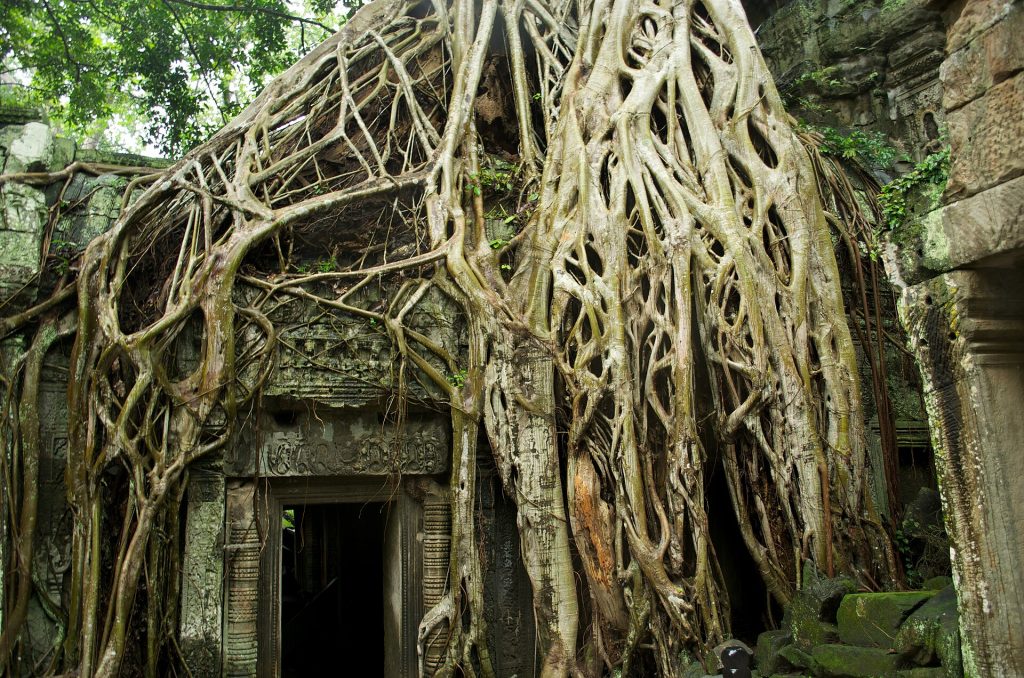
The small circuit is day one. See Angkor Wat at sunrise and be at the entrance at five. Then you cross into Angkor Thom, where the two hundred stone faces of the Bayon temple look at you from every side. The Ta Prohm temple, meanwhile, is wrapped in tree roots, and the Tomb Raider film was shot right there.
The grand circuit is day two. Preah Khan, Neak Pean and Pre Rup are on that route, and at the last of them people watch the sunset.
Give the third day to the far temples. Banteay Srei is known for its pink stone carving, Beng Mealea has been left to the jungle, and on Mount Kulen there are waterfalls.
The practical side goes like this. A day with a tuk-tuk driver is 20–30 dollars and a guide 40–50. At the temples shoulders and knees must be covered, or they will not let you in. In Siem Reap, Pub Street and the night market come alive in the evening, while the floating villages on Tonlé Sap lake take half a day.
Phnom Penh, Kampot, Kep and the Koh Rong islands
Phnom Penh is the capital, on the bank of the Mekong. The Royal Palace and the Silver Pagoda, the National Museum, the Central Market and the riverside walk combine into one route.
The Tuol Sleng prison museum and the Choeung Ek “Killing Fields” explain the tragedy of the Khmer Rouge in 1975–1979. They are heavy places and you come out of them silent, but you have to go to understand the country. Two days are enough for the city.
Kampot in the south is a quiet French colonial town on a river. The world-famous Kampot pepper plantations and Bokor mountain are there, while Kep by the sea is known for its crab market; the two together take two or three days.
You reach the islands of Koh Rong and Koh Rong Samloem from Sihanoukville by fast boat in forty-five minutes. White sand, plankton glowing in the water at night and the calm the Thai islands had twenty years ago await you there. Sihanoukville itself has turned into a casino town, so do not stay there; go straight onto the boat. Battambang, with its bamboo train and village life, is a trip of its own.
Transport in Cambodia: tuk-tuks, buses, dollars
Inside the cities the tuk-tuk is the main means; Grab and the local PassApp show the price, 1–3 dollars, and there is no need to haggle. Between cities the Giant Ibis and Mekong Express buses run, and seats can be booked online. Siem Reap to Phnom Penh takes six hours and costs 15 dollars, with Wi-Fi and air conditioning on board. There is a night bus as well. Phnom Penh to Kampot is three and a half hours. By air Siem Reap is an hour from Phnom Penh at 50–80 dollars. You can cross overland from Bangkok at the Poipet border, but there is a lot of visa fraud at the border, so get the eVisa at home.
Money in Cambodia works in its own way. Everything is paid in dollars and the change comes back in riel, nobody takes a torn or old dollar note, and breaking a hundred-dollar bill is an ordeal, so bring fresh one, five and ten dollar notes from Baku. The cash machines give dollars, with a commission of 4–5 dollars. Cards work only in hotels and big restaurants.
Khmer food and halal
Amok is a fish curry cooked in coconut milk in a banana leaf, and that is the national dish. Lok lak is beef fried with a lemon and pepper sauce. Khmer curry is milder than Thai curry and so is a comfortable option for those who cannot take heat. Nom banh chok is rice noodles served for breakfast, and crab with Kampot pepper is the symbol of Kep.
Prices are low. Street food is 1–2 dollars, lunch at a restaurant 4–8, and at a tourist restaurant 10–15, while tropical fruit, mango especially, is cheaper than water.
Halal food is available in Phnom Penh and Siem Reap at the restaurants of the Cham Muslims and at Malaysian cafés; the Cham community is the country’s largest religious minority. Seafood and vegetarian options are found everywhere. Do not drink the tap water; ice in the tourist places is factory-made and safe.
Read next: A Cambodia visa: the 36-dollar eVisa, the visa on arrival and steering clear of middleman sites
Season and safety in Cambodia
November to February is the dry season and, at 25–30 degrees, the ideal time, while December and January are the busiest period.
From March to May the temperature climbs to 35–40 degrees. The temples are only walked early in the morning, and at midday you sit at the hotel by the pool.
June to October is the rainy season, with a short downpour in the afternoon. Angkor’s pools fill up and everything turns green, tourists thin out and hotels get 30–40 per cent cheaper. The rainiest months are September and October.
As for safety, bag snatching from motorbikes happens in Phnom Penh. Do not hold your bag on the road side and keep it in your lap in a tuk-tuk; Siem Reap is relatively calm. Do not step off the country roads or into unmarked fields, because old minefields are still there. Take mosquito spray against dengue. Information on the Angkor Pass and the regions is on the Tourism Cambodia portal.
Budget and tickets
Cambodia is one of the cheapest countries in South-East Asia. In Siem Reap a guesthouse with a pool is 15–30 dollars, a boutique hotel 50–80 and a five-star 120–200. On Koh Rong a bungalow comes down to 30–60 dollars. If you want to stay close to Angkor, make your hotel choice before the season.
The Angkor Pass is 62 dollars, a tuk-tuk day 25 and a Tonlé Sap tour 20. Leaving out the flight, a ten-day trip fits into 600–900 dollars a head.
From Baku there are flights with Qatar Airways to Phnom Penh via Doha and to Siem Reap via Bangkok. When looking for an air ticket to Siem Reap, flying to Bangkok and continuing with an hour’s flight from there often works out cheaper. For those touring Angkor, Phnom Penh and the islands on one itinerary, Cambodia and Thailand tour packages combine two countries in one trip, and Thailand gives citizens of Azerbaijan a visa on arrival.
Frequently asked questions about Cambodia
How many days do you need for a Cambodia trip?
Three days for Angkor, two for Phnom Penh, two for Kampot and Kep, three for the islands: ten in all. For Angkor alone you can also add three or four days to a Thailand trip.
How many days should the Angkor Wat ticket be for?
Three days. The small circuit in one day is exhausting in the heat, and the seven-day pass is only for archaeology enthusiasts.
Can it be combined with Vietnam or Thailand?
Yes, the bus from Phnom Penh to Ho Chi Minh City is six hours and the flight from Siem Reap to Bangkok an hour. Vietnam requires an eVisa from citizens of Azerbaijan and Thailand a visa on arrival.
In closing
With an easy eVisa, payment in dollars and the most magnificent temple complex in the world, Cambodia is one of the cheapest and most affecting trips in Asia; for someone going in the dry season with a three-day Angkor Pass it is the ideal plan. The visa process is explained on the Cambodia page, and to build the Angkor and island route together fill in the application form.
Note: the prices here are as of the publication date and can change with the season.
